The Short Answer: Every Single One
Yes, every classic Land Rover Defender built between 1983 and 2016 is a permanent 4x4 vehicle. The system utilizes an LT230 two-speed transfer case that provides permanent four-wheel drive to both the front and rear live axles, managed by a manually lockable center differential. There is no 2WD mode on a classic Defender.
But answering "are Defenders 4×4" with a simple yes misses the real story. The Defender's four-wheel drive system wasn't just an engineering checkbox. It was the foundation of a platform that served over 170 militaries, crossed every continent including Antarctica, and earned a reputation that, frankly, no other civilian vehicle has ever matched. So let's get into the specifics, because the devil and the genius are both in the details.
How Does the Classic Defender Permanent 4x4 System Work?
The heart of the classic Defender's drivetrain is the LT230 two-speed transfer case. It's a gear-driven unit (no chains, no clutch packs in the original configuration) that provides permanent drive to both axles through an integral center differential[2]. The system uses three differentials total: one in the transfer case, one in the front axle, one in the rear axle[5].
Here's the thing. That center differential allows the front and rear propshafts to rotate at different speeds, which is essential for turning corners on hard surfaces without binding the drivetrain[2]. A manually operated lever locks this center differential solid when conditions demand it, forcing equal torque distribution front to rear.
The LT230 offers two ranges. High range runs at approximately 1.41:1 on most Defenders, while low range drops to 3.2:1[2]. That low range, combined with first gear in the gearbox, gives the Defender a crawl ratio that lets you creep over obstacles at walking pace with precise throttle control. We've pushed trucks through situations where the speedometer reads zero but all four wheels are still turning.
The LT230T was the most common variant, fitted to five-speed manual Defenders from launch. The LT230Q arrived with the Td5 engine and was, as the suffix suggests, quieter in operation thanks to different gear geometry and improved bearings[2]. Both share the same external dimensions and bolt pattern.
| Component | Specification / Ratio | Function |
|---|---|---|
| High Range Ratio | 1.41:1 | Standard on-road and light trail driving |
| Low Range Ratio | 3.2:1 | Technical rock crawling at walking pace |
| LT230T Variant | Standard Geared | Original fitment, highly durable |
| LT230Q Variant | Revised Geometry | Quieter operation, fitted to Td5 models |
They're also nearly unkillable. I've seen LT230 units survive on 80W-90 gear oil that looked like chocolate milk. Not recommended. But telling.
Live Axles: Why the Old Way Still Matters
The classic Defender uses beam axles front and rear, suspended on coil springs. The front axle is a Salisbury-type unit (on later models), and the rear axle varies between Rover and Salisbury depending on model year and specification. Both contain open differentials from the factory[7].
Open diffs on a vehicle designed to go anywhere? Sounds like a contradiction. And in some situations it is. An open differential sends power to the wheel with the least resistance. If one front wheel lifts off the ground on a rock step, all the torque goes to that spinning wheel and you go nowhere[5]. This is why locking the center diff is step one off-road, and why serious overlanders fit aftermarket axle lockers like ARB Air Lockers or Terrafirma e-lockers.
But here's what live axles give you that independent suspension never can: articulation. When one wheel drops into a rut, the opposite wheel rises by exactly the same amount. The axle stays rigid. The spring compresses on one side and extends on the other. You maintain ground contact. There's no geometry change, no camber shift, no CV joint angle limits. Just a steel tube holding two wheels apart while the chassis above does whatever it needs to.
The classic Defender's beam axles, combined with a locked center diff and one aftermarket rear locker, will outperform many modern independent-suspension 4x4s in serious off-road conditions. Not on the road, mind you. On the road, live axles ride like a farm implement. But in the bush? That simplicity is strength.
Off-Road Geometry: The Numbers That Matter
The classic Defender 90's off-road geometry is exceptional, partly because Land Rover's engineers in Solihull weren't trying to make it pretty. They were trying to make it clear obstacles. The result was minimal front and rear overhangs that translate into steep approach and departure angles.
From the factory specification data for the classic Defender 90:
| Specification | Classic Defender 90 | Classic Defender 110 | Modern L663 Defender |
|---|---|---|---|
| Approach Angle | 49° | 49° | 38° |
| Departure Angle | 47° | 35° | 40° |
| Ground Clearance | 250mm (9.8 in) | 250mm (9.8 in) | 291mm (11.5 in) |
| Wading Depth | 500mm (20 in) | 500mm (20 in) | 900mm (35.4 in) |
The Defender 110 trades some of that geometry for wheelbase length. Its departure angle drops to around 35° and the breakover angle changes with the longer 110-inch wheelbase[1].
Compare those figures to the modern L663 Defender 110, which Land Rover designed to match or exceed the classic's geometry: 38° approach, 28° breakover, and 40° departure[3]. The modern truck does this with 291mm of ground clearance and 900mm wading depth[3]. Very impressive. But the classic 90, with its stubby overhangs and live axles, still holds its own on raw approach and departure numbers, and it did it without a computer.
Builder's Note: A 2-inch suspension lift on a classic D90 with 265/75R16 tyres pushes ground clearance past 10.5 inches and further improves all angles. At Monarch, we spec heavy-duty springs and extended-travel shocks on builds to reclaim what decades of bushing sag steal from the original geometry.
The Camel Trophy Proved It. Fifty Countries Believed It.
If you want to know whether Defenders are 4×4 capable, don't ask an engineer. Ask the people who drove them through jungles.
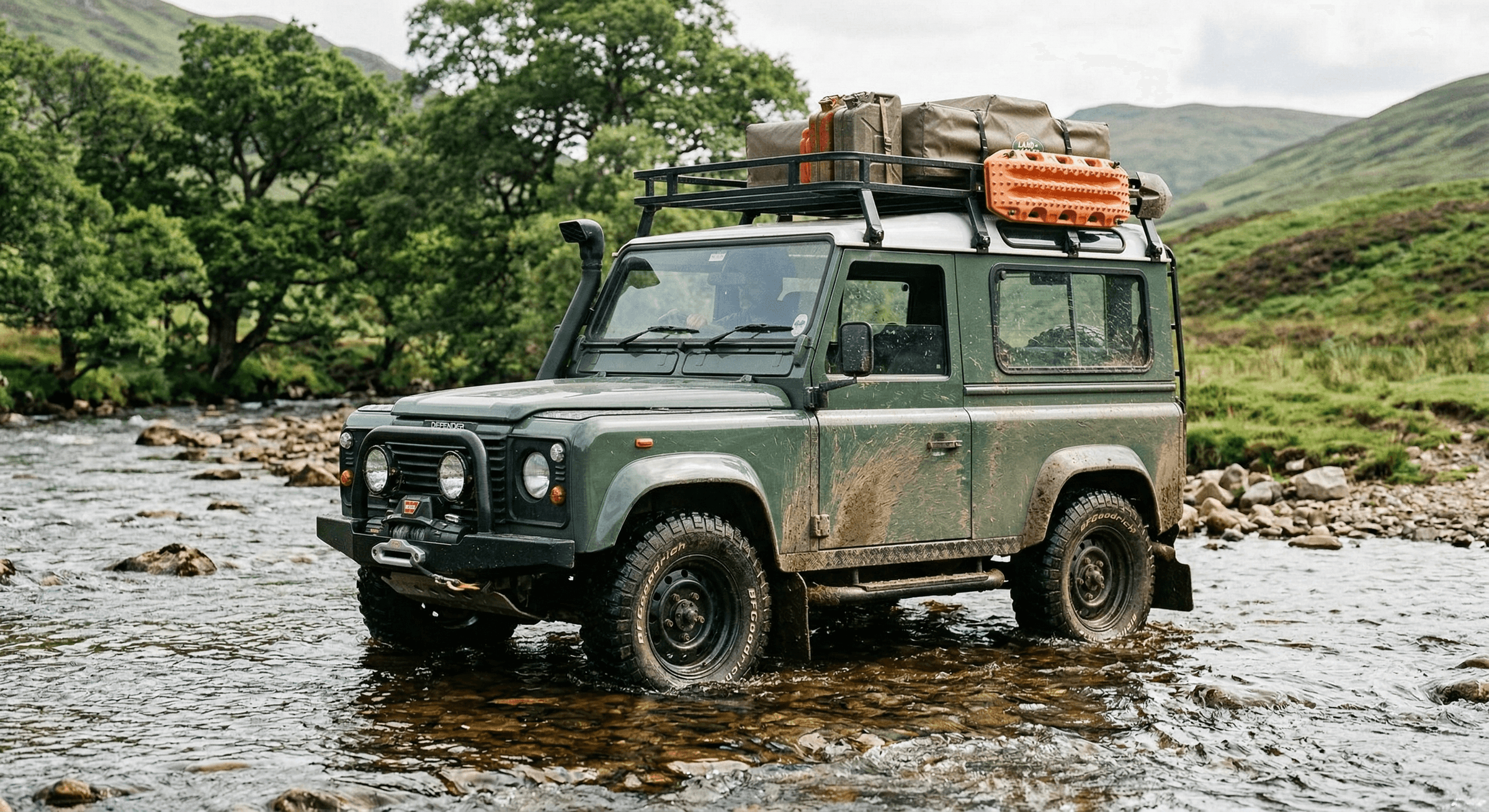
The Camel Trophy ran from 1980 to 2000, and from 1981 onward, Land Rover was the exclusive vehicle partner[4]. Defenders and other Land Rover models were driven through Borneo, Madagascar, Siberia, and the Amazon in their distinctive sandglow yellow livery. The 1987 Madagascar event saw Defender 90s and 110s cover over 1,000 miles of jungle, red mud, and river crossings[4]. The vehicles were modified by Land Rover Special Vehicles with snorkels, winches, and protection equipment, but the core drivetrain, the permanent 4WD system with the LT230, remained factory.
The British military came to the same conclusion. The Defender Wolf (XD specification) served the British Army for decades in configurations ranging from patrol vehicles to weapons platforms. The Australian Defence Force ordered thousands of Defender 110s, called the Perentie, some in 6x6 configuration[1].
What does that tell you? It tells you that organizations whose survival depends on vehicle reliability, not marketing, chose the Defender's 4×4 system. Repeatedly.

What Are the Common Problems with Classic Defender 4x4 Systems?
The classic Defender 4×4 system is not without flaws. Let me be specific.
No factory axle lockers. The open front and rear differentials are the system's biggest weakness for serious off-road use. Land Rover never offered a factory axle locker on the classic Defender. As Land Rover Monthly has documented, fitting aftermarket lockers like the Terrafirma e-locker (part number TF450, from about £700) is a bolt-in replacement of the original equipment differential[7]. But it's still an aftermarket addition.
The swivel housings leak. Always. The ball joints that allow the front wheels to steer while delivering drive through constant-velocity joints are sealed by a combination of oil seals and, in some cases, grease. These seals degrade. If you own a classic Defender long enough, you'll develop an intimate relationship with swivel housing maintenance.
The wading depth is modest. At 500mm (20 inches) stock, the classic Defender's wading capability is significantly less than the modern L663's 900mm. A snorkel helps with engine air supply, but the real limitation is the electronics (on later Td5 and Puma models) and the breather hoses on the axles and gearbox. At Monarch, we extend all breather lines to roofline height and weatherproof all electrical connections.
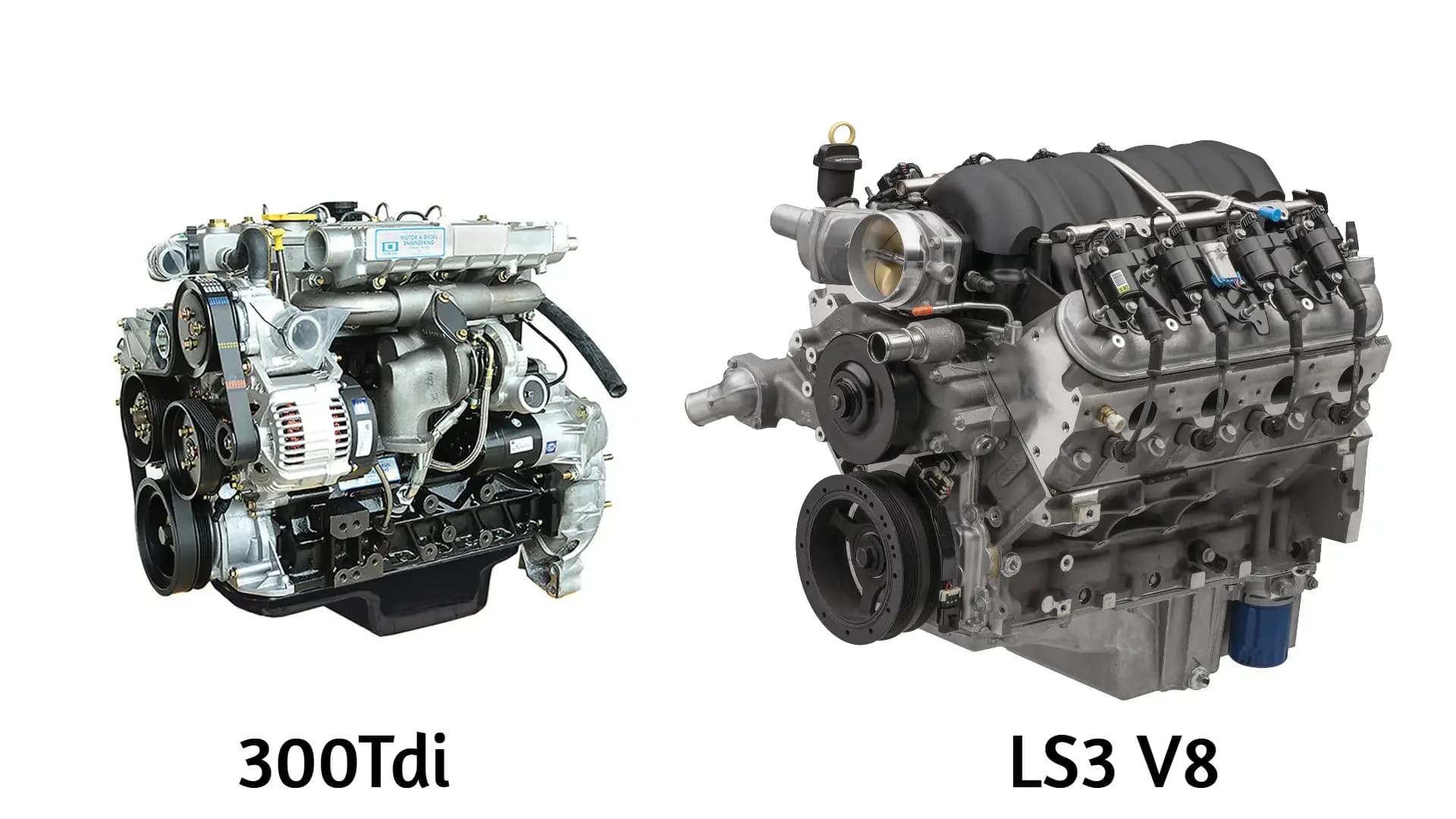
Power. A 300Tdi makes 111 horsepower. That's not a typo. It's 111 horses pulling roughly 4,200 pounds of vehicle. On-road, it is agricultural. Off-road at low speed, the torque (195 lb-ft) is adequate. But if you want a Defender that can actually merge onto a highway without a prayer, you need a different engine.
The Restomod Answer: Classic 4×4 Soul, Modern Muscle
This is where the conversation shifts for collectors and enthusiasts who want the Defender's legendary off-road DNA but refuse to live with 1990s compromises.
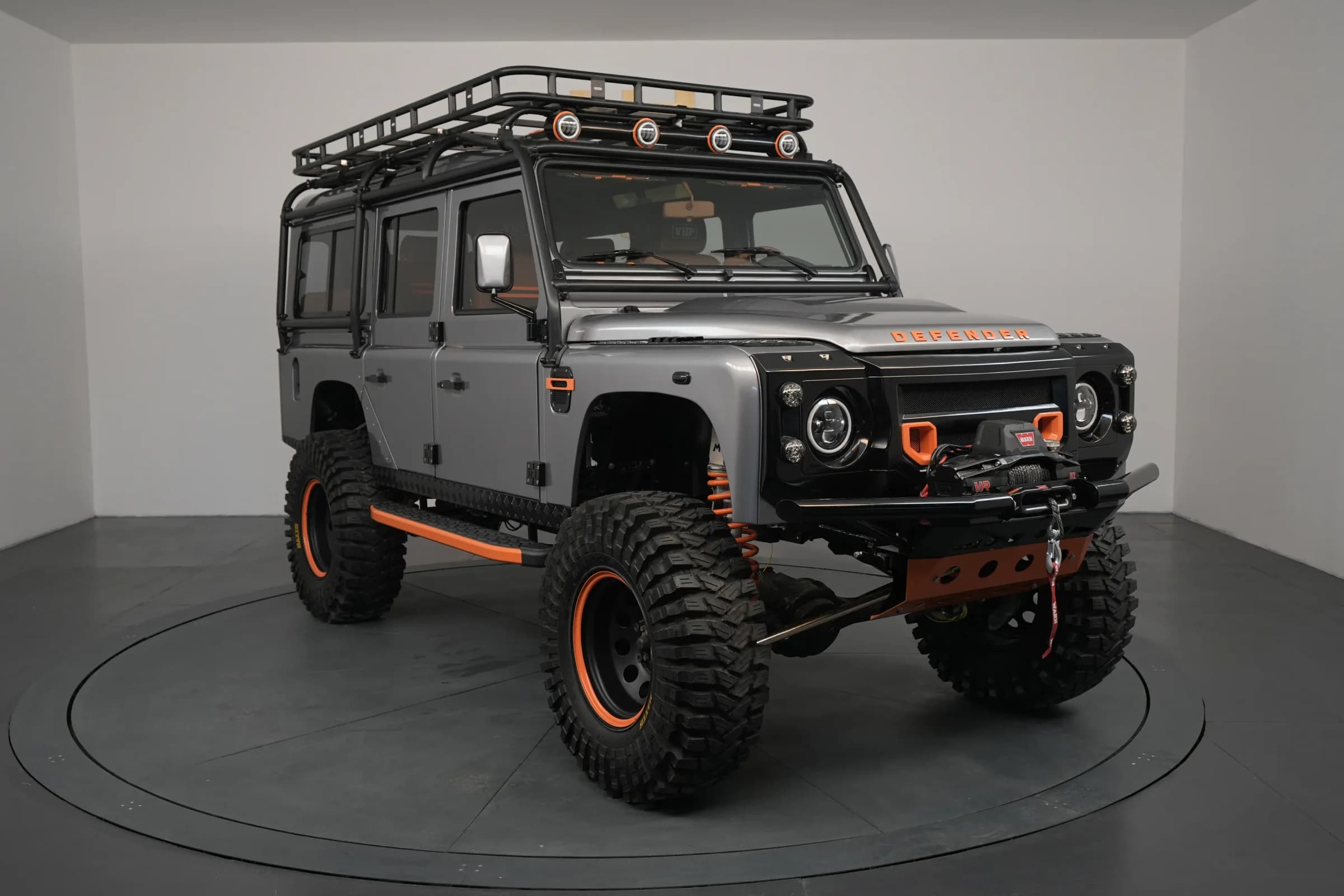
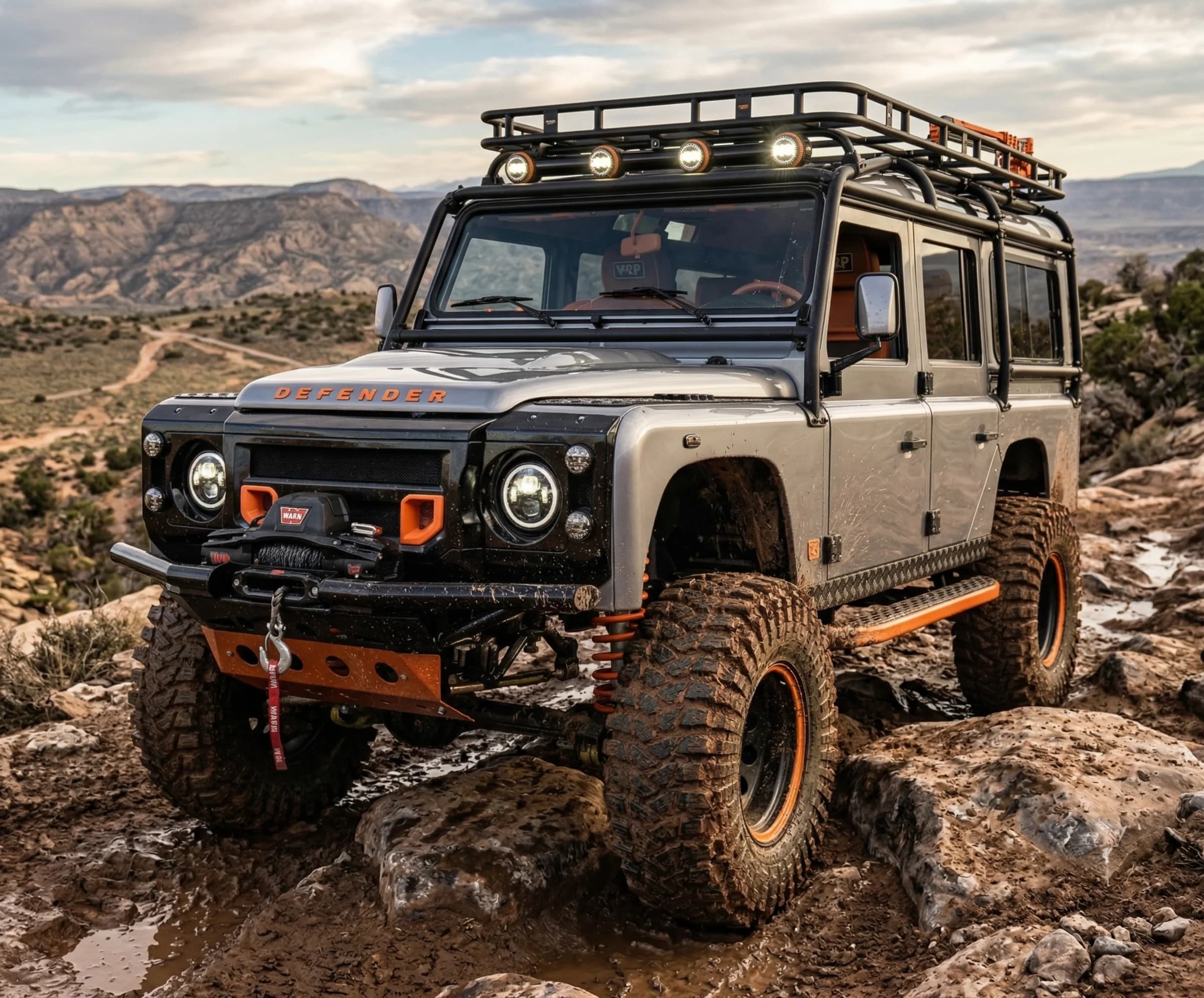
At Monarch, we install GM LS3 (430 hp, 424 lb-ft) or LT1 (460 hp, 465 lb-ft) V8 engines into classic Defender chassis, paired with the 6L80E six-speed automatic transmission. That transmission bolts to the original LT230 transfer case via a billet aluminum adapter. The permanent 4WD system, the center diff lock, the two-speed range, it all stays.
| Engine Type | Horsepower | Torque | Drivability Context |
|---|---|---|---|
| Original 300Tdi | 111 hp | 195 lb-ft | Agricultural, low-speed off-road |
| GM LS3 V8 (Restomod) | 430 hp | 424 lb-ft | Modern highway merging, high performance |
| GM LT1 V8 (Restomod) | 460 hp | 465 lb-ft | Premium power, exceptional towing |
What changes is everything around it. The chassis gets hot-dip galvanized to prevent the corrosion that destroys original frames from the inside. The wiring harness is built new, not adapted from Lucas electrics (if you know, you know). Heavy-duty springs and dampers restore and exceed original ride height. A proper exhaust system routes the V8's 430 horses without cooking the fuel tank.
The result? A vehicle that answers "are Defenders 4×4" the same way the original did, with three differentials, a lockable center diff, and live axles, but does it with more than four times the horsepower and a transmission that doesn't require you to have grown up driving tractors in Warwickshire.
What the Market Says About Capability
There's a financial dimension to this. The classic Defender's off-road capability is a significant part of what drives collector values. NAS Defender 90 Soft Top models now average around $78,340 at auction[6]. The highest recorded NAS D90 sale hit $212,800 in late 2025. The last Defender Heritage Edition, built on the final day of production, January 29, 2016, with only 4,597 miles, was expected to set new records when it came to market[8].
These aren't just pretty trucks. Collectors pay for provenance and capability. A Defender that is been properly built to exploit its 4×4 potential, not just sit in a climate-controlled garage, commands a specific kind of respect. And price.
Production ended in 2016. Roughly 7,059 NAS Defenders were built for the American market between 1993 and 1997[1]. That number only shrinks. Every year, more trucks rust out, crash, or get abandoned. The math isn't complicated.
Classic Defender vs. Modern Defender: Which is Better Off-Road?
Someone is going to ask. So let me address it directly.
The modern L663 Defender is an exceptional vehicle. Its Terrain Response 2 system analyzes road conditions and adjusts settings automatically. It has electronic locking differentials. It wades to 900mm[3]. It has 11.5 inches of ground clearance with air suspension. It is, by every measurable metric, more capable than the classic in controlled testing conditions.
But.
The modern Defender uses a monocoque body and fully independent suspension. It doesn't have a separate ladder chassis. It does not have live axles. It relies on software and sensors to manage traction. When something breaks in the Sahara, you need a laptop. When something broke on a classic Defender in the Sahara, you needed a wrench and probably some wire.
Different tools. Different philosophies. Both legitimate. But if you're asking whether the classic Defender is a real 4×4, the answer is that it was designed from the ground up as nothing else. It's not an SUV with off-road pretensions bolted on. It is an off-road vehicle that people happened to drive on roads.
Commencing Your Commission
The classic Defender's 4×4 system is the reason these vehicles exist. It is the engineering core that earned their reputation across six decades and every continent. At Monarch, we build on that foundation. Our 12-stage ground-up process begins with the chassis and the drivetrain, because without the permanent four-wheel drive system working perfectly, nothing else matters.
If you want a Defender that honors 75 years of off-road heritage while delivering an experience the original engineers would have envied, start your commission today and speak with our build team. We'll walk you through donor selection, powertrain options, and every detail of the build from frame to finish.