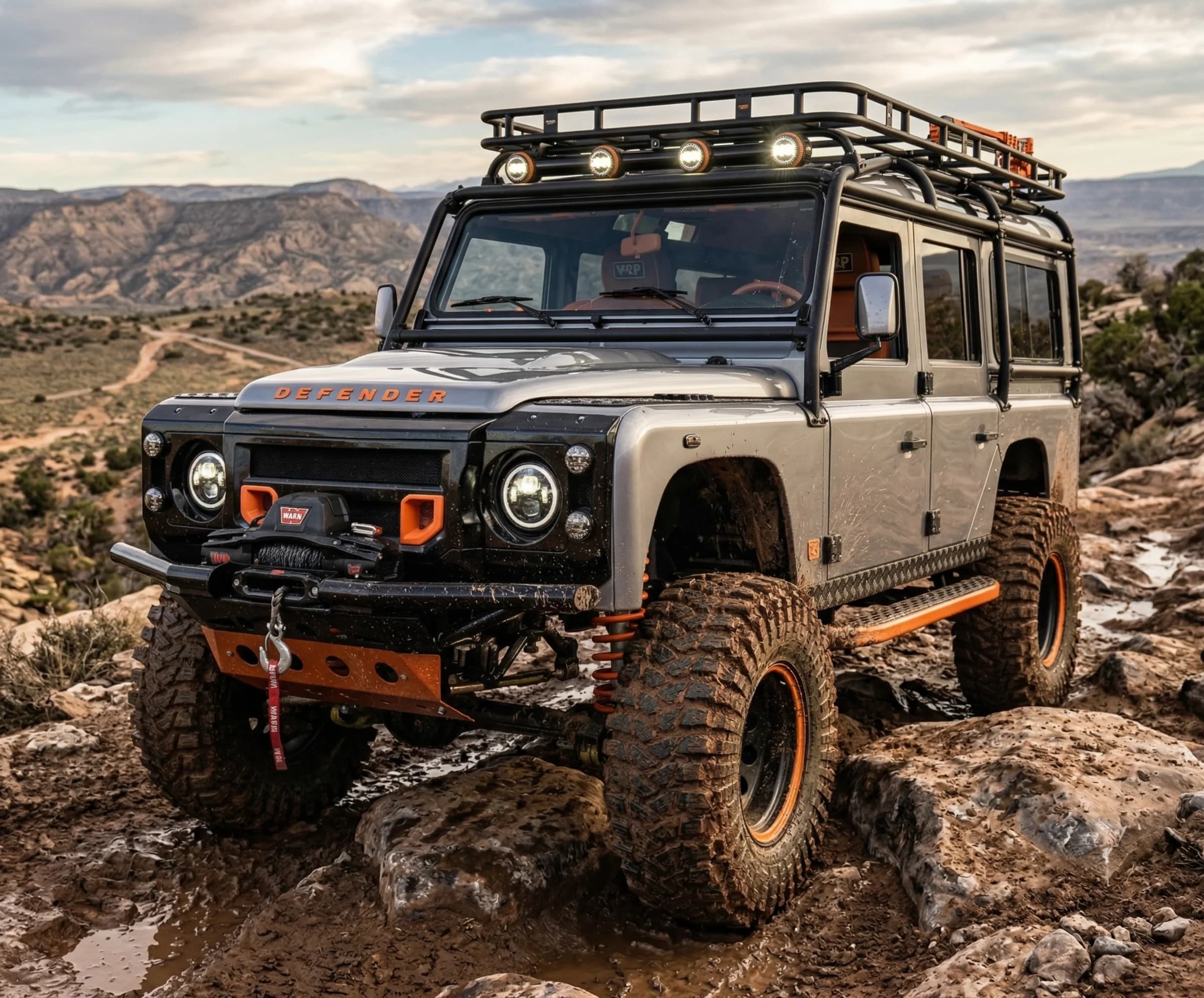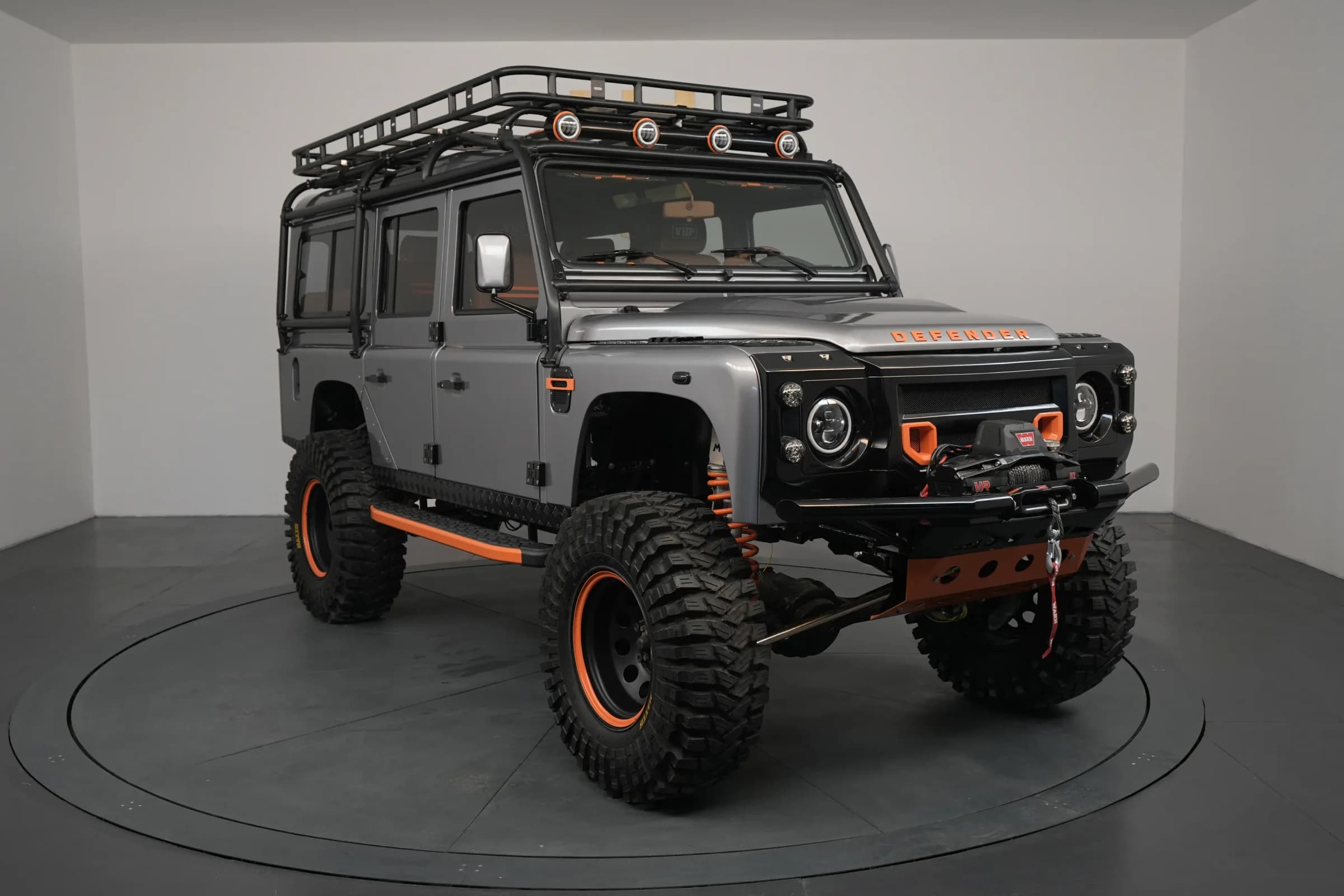
The History of the 4x4 Defender Land Rover System
Somewhere on a beach in Anglesey, Wales, in 1947, Maurice Wilks scratched a shape into the sand with a stick. That rough outline became the Land Rover. And the 4x4 system born from that sketch, refined over seven decades of mud, sand, rock, and snow, eventually produced the most capable off-road platform the world has ever known: the classic Defender.
I've overseen ground-up Monarch builds since 2016. Every single one teaches me something. But the thing that never changes, the constant across every chassis and every era, is how profoundly right Land Rover got the 4x4 Defender's drivetrain architecture. It's the reason aid workers in the Congo, sheep farmers in Wales, and collectors in Connecticut all gravitated to the same vehicle.
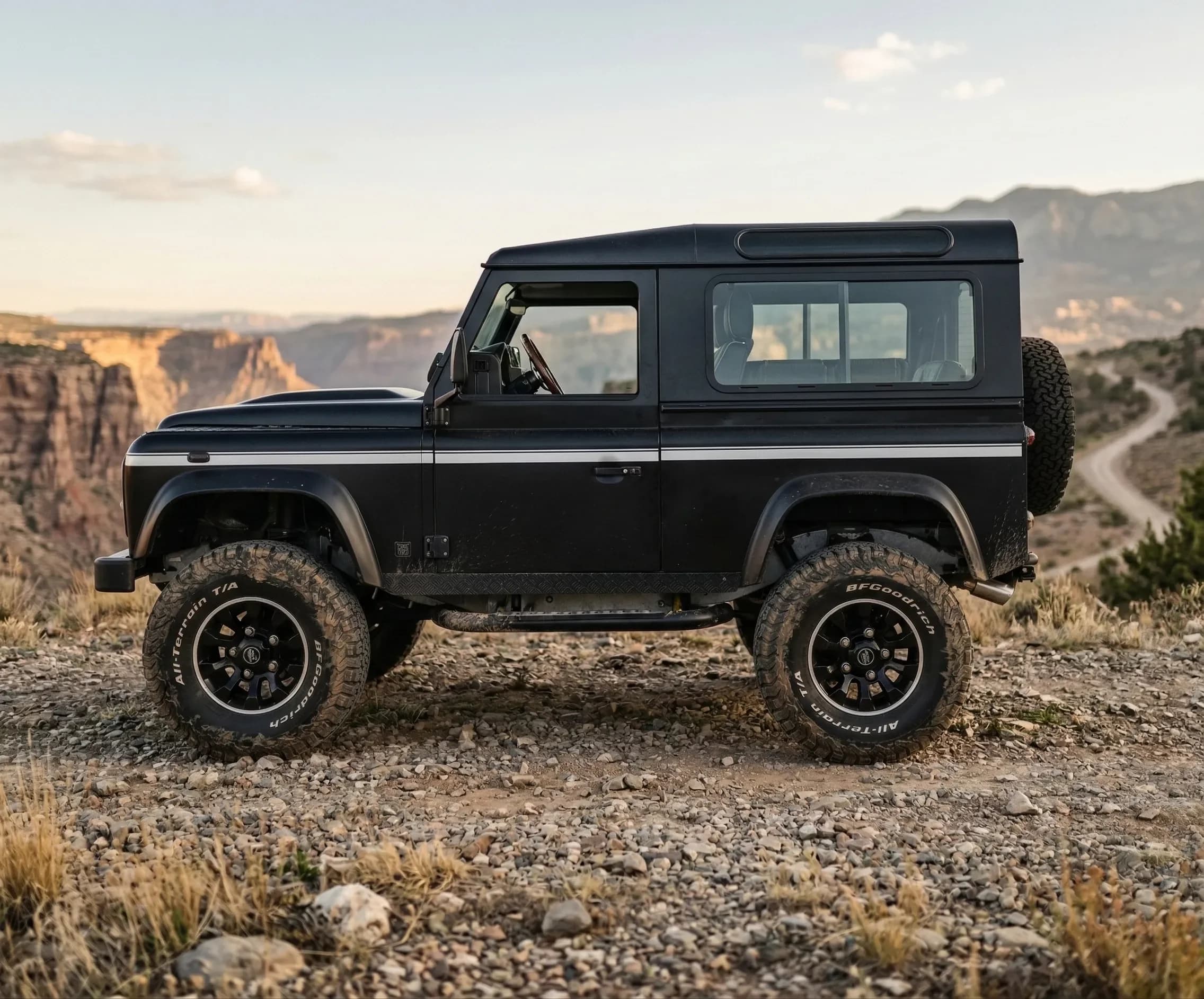
So what actually makes the classic Land Rover Defender's 4x4 system different from, say, a Toyota Land Cruiser or a Jeep Wrangler? That's the question worth answering honestly
How the Classic 4x4 Defender Land Rover Drivetrain Works
Most 4x4 trucks of the classic Defender's era used part-time systems. You drove in two-wheel drive on pavement, then manually engaged the front axle when things got rough. Simple. Effective. But limited.
Land Rover took a different approach. The LT230 transfer case is the heart of the Defender's four-wheel drive system. It transfers drive from the gearbox to the front and rear axles, and unlike earlier transfer boxes on Series Land Rovers, the LT230 provides permanent drive to both axles via an integral center differential. This center differential allows the relative speeds of the front and rear propshafts to vary, which is necessary when turning corners.
Three differentials. Front. Rear. Center. All four wheels driven, all the time.
The original classic Defender employs full-time 4WD and a lever-operated manually locking center diff. That lockable center differential is where things get interesting for off-road work. When you pull that yellow lever in the cab (and if you've driven one, you know the feel of it, that satisfying mechanical clunk), you lock the center diff and split torque 50/50 between front and rear axles.
That 3.2:1 low range is serious crawling capability. In practical terms, it means the classic 4x4 Defender Land Rover can idle up a gradient that would stall most modern SUVs.
| Feature | Classic Defender (LT230) | Standard Classic 4x4s |
|---|---|---|
| Drive Type | Permanent 4WD (Full-Time) | Part-Time 4WD (RWD on pavement) |
| Center Differential | Yes (Manually Lockable) | No (Direct mechanical link when engaged) |
| Low Range Ratio | Massive 3.32:1 (Extreme crawling) | Typically 2.0:1 to 2.7:1 |
| Suspension Base | Coil Springs (High Articulation) | Leaf Springs (Stiff, lower articulation) |
Three Wheelbases, One Mission
The coil-sprung Land Rover was introduced in 1983 as the "Land Rover One Ten", and in 1984 the "Land Rover Ninety" was added. The "Defender" name wouldn't appear until 1990, when Land Rover needed to distinguish its utility truck from the newly launched Discovery.
Here's the lineup, broken down by someone who has built all three:
- Defender 90: 92.9-inch wheelbase. Short, nimble, and the collector favorite. Best breakover angle of the three. Terrible cargo space.
- Defender 110: 110-inch wheelbase. The practical one. Four doors, actual rear seats, and enough room behind the second row for expedition gear. This is what armies and aid organizations ordered by the thousands.
- Defender 130: 127-inch wheelbase. Never sold in North America. Built by literally cutting a 110 chassis in half and welding in extra steel. Rarest of the three.
P.S. Want to learn more? Check out our in-depth guide comparing the defender 90, 110 and 130.
All three shared the same permanent 4x4 system, the same transfer case architecture, the same live axles. The wheelbase changed. The soul didn't.
The last Land Rover Defender rolled off the production line with the number plate H166 HUE, a reference to the first ever pre-production Land Rover, registration 'HUE 166'. This was the 2,016,933rd Defender to be produced[1].Two million trucks. Let that number breathe for a second.
The Engine Eras: From Wheezy Diesel to American V8
The classic Defender 4x4 wore many engines across its 33-year run. Not all of them were good. Let me be direct: the Td5 is the worst engine Land Rover ever put in a Defender. The head gasket failures, the oil-in-the-harness-connector problem, the ECU drama. People will argue with me on this. They're wrong.
But the 300Tdi? That's a different story entirely.
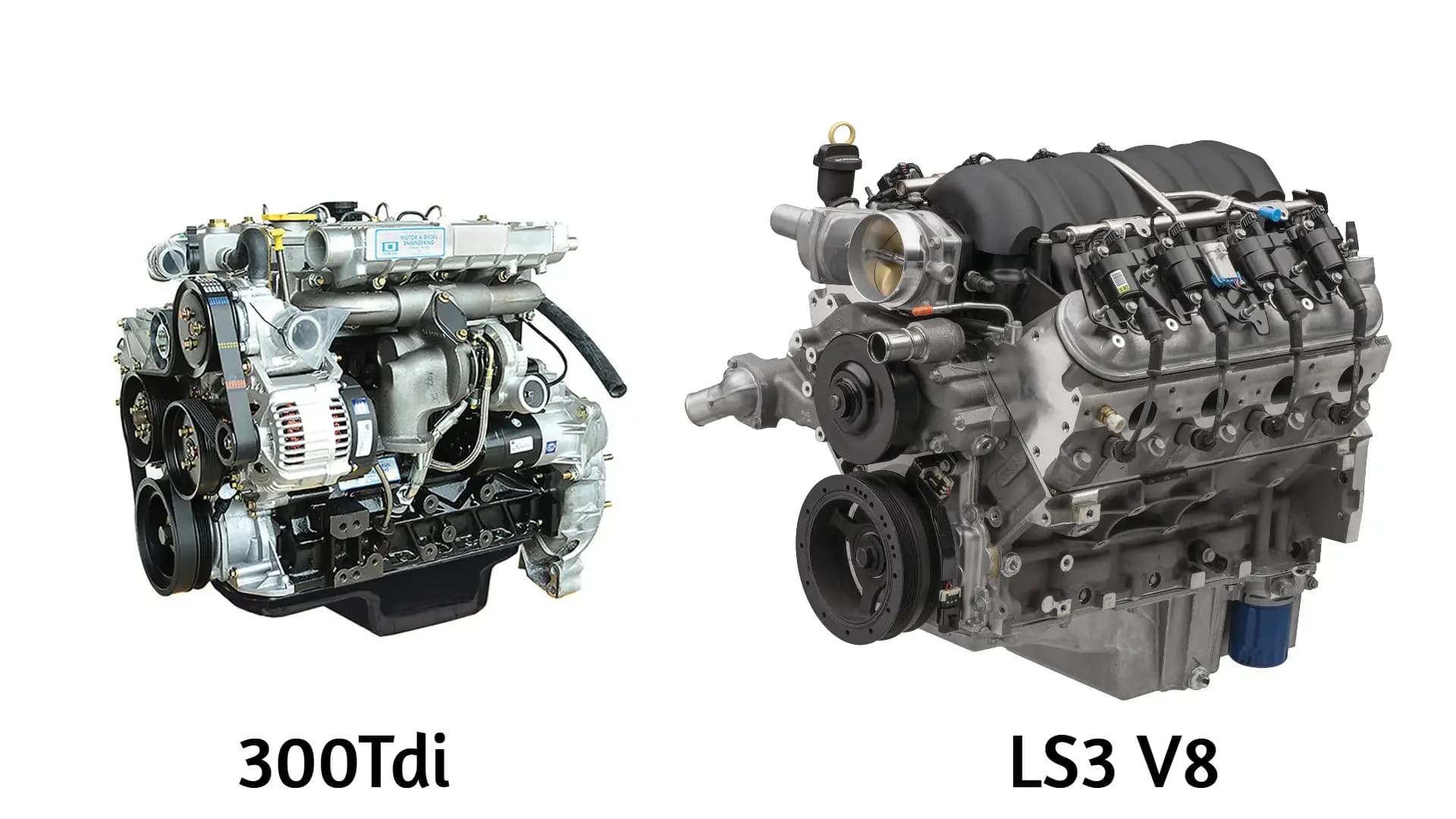
The 300Tdi has a capacity of 2495cc, produces 195 lb-ft (264 Nm) of torque, and was an evolution upon the earlier 200Tdi with many improvements and refinements for better on-road performance. The 300TDi is a 2.5-liter turbocharged diesel engine producing 111 hp at 4,000 rpm and 195 lb-ft of torque at 1,800 rpm.111 horsepower. That's it. And yet this engine powered military convoys, crossed the Sahara, and earned a reputation as the most reliable powerplant Land Rover ever designed. Land Rover continued to make the 300Tdi for the export market and the British Army, who deemed the electronic control unable to guarantee protection against Electromagnetic Pulse (EMP) weapons. When the British military chooses your engine specifically because it has no electronics that can be fried by an EMP, you know you've built something special.
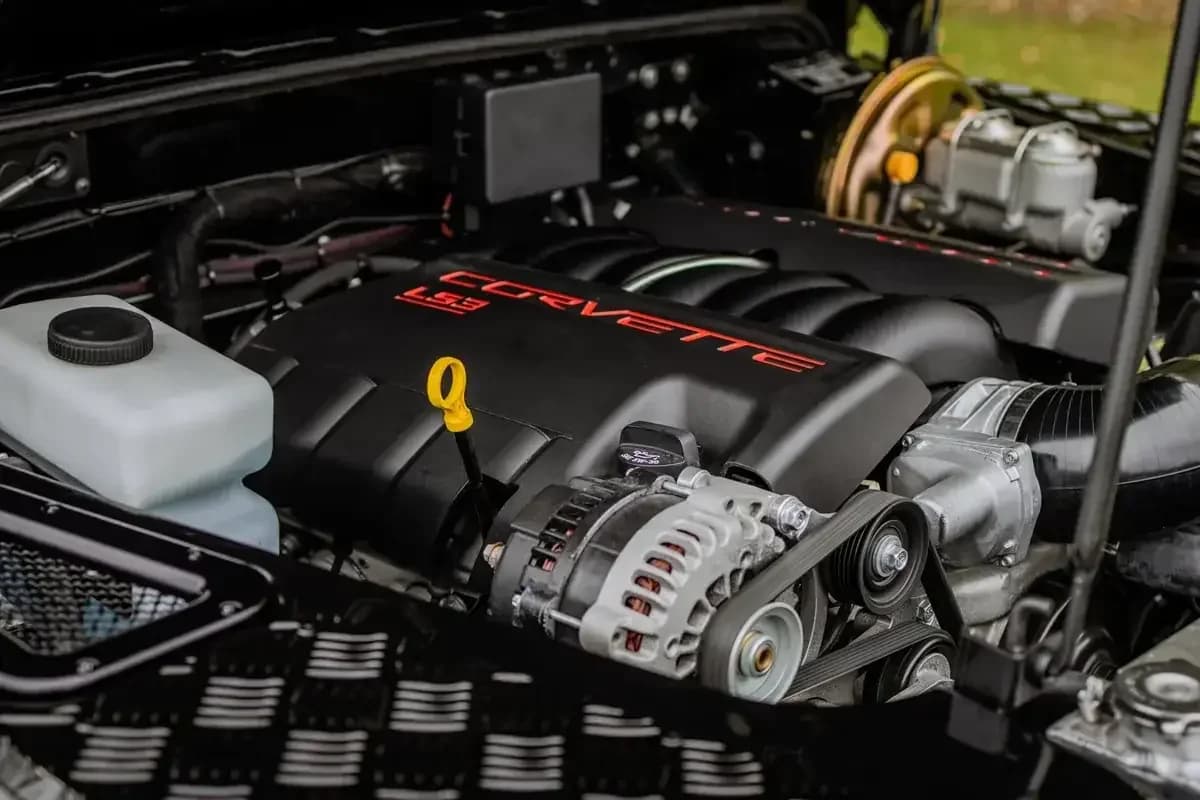
The NAS (North American Specification) Defenders, sold in the US from 1993 to 1997, came with 3.9-liter and later 4.0-liter V8 petrol engines. They were fitted with the 3.9-litre V8 petrol engine, LT-77 five-speed manual transmission and LT230 transfer case. Adequate power, but paired with a four-speed automatic on later models, the driving experience was... let's call it leisurely.
At Monarch, we solve this with the GM LS3 (about 430 hp), LT1 (about 460 hp) or supercharged LT4 (650 hp), each mated to a 6-speed automatic, and we also offer EV builds. The first time I heard a 6.2L LS3 turn over in a Defender chassis, I stood there grinning like an idiot. That is 430 horsepower running through a drivetrain architecture designed for 111. The permanent 4x4 system handles it. The LT230, properly rebuilt and regeared, handles it. A new Monarch chassis, engineered for the power, handles it. The Defender was overbuilt from day one, which is exactly why it accepts modern power so gracefully.
Builder's Insight: The 6L80E transmission requires approximately 42mm of additional tunnel clearance when mating to the Defender's body. We address this during our 12-stage build process, before the body goes back on the chassis. It's not something you want to discover after paint.
Off-Road Specs of the 4x4 Defender Land Rover
Numbers tell the story better than adjectives here.
The classic Defender 90 offers approach and departure angles that most modern SUVs can only dream about. That boxy, upright body isn't a styling choice. It is geometry. Short front and rear overhangs mean the bumpers clear obstacles that would crumple a modern crossover's plastic cladding. The solid beam axles, located by radius arms and a Panhard rod, provide massive wheel articulation. When one wheel drops into a rut, the opposite wheel lifts. The body stays level. The permanent 4x4 system keeps feeding power to whatever has traction.
The permanent four-wheel-drive system with lockable center differential ensures traction in challenging conditions, while the coil-spring suspension provides impressive articulation for maintaining wheel contact on uneven terrain.Coil springs. That was the big leap from the leaf-sprung Series trucks that preceded the Defender. When Land Rover moved to coils in 1983, they borrowed the concept from the Range Rover and applied it to a working truck. The result was a vehicle that could carry a ton of cargo, tow livestock trailers through fields, and still articulate its suspension enough to keep all four wheels on the ground while crawling over boulder fields.
Is it comfortable on the highway? No. Not stock, anyway. The live axles transmit every road imperfection directly into the cabin, the steering wanders if you blink, and wind noise above 60 mph is (I'm being generous here) "agricultural." But none of that matters if your destination requires fording a river or climbing a hillside that would send a G-Wagon running back to Stuttgart.
The Market: Why Classic 4x4 Defenders Keep Climbing
They made about 2 million of these original Land Rovers, but they remain a rarity in the U.S. For those who are beguiled by a Defender, the prices are driven by a micro-economy that places the supply well below the demand.Hagerty, the authority on collector vehicle valuation, placed the 1983–97 Land Rover Defender on their 2022 Bull Market List at an excellent condition starting price of $61,400 [3]. That was 2022. The market has only steepened since.
The highest recorded sale was $212,800 for a 1997 Land Rover NAS Defender 90 on November 21, 2025. The average price of a NAS Defender 90 Hard Top is $75,285. The spread between a rough project and a pristine time capsule has widened dramatically. A ratty 300Tdi imported from Europe might cost $22,000. A low-mileage NAS 90 with original paint and documentation can pull $150,000 or more.
And then there's the factory option. Plan on spending at least £190,000, excluding taxes, to put a classic Land Rover Defender that has been rebuilt and modified at the factory in your garage. That's about $253,000 at the current conversion rate.
Quarter-million dollars. For a truck whose architecture dates to 1983. That tells you everything about demand.
Market Reality: A Defender that looks like a bargain at $30,000 can easily consume $80,000 or more in build costs if the chassis, bulkhead, and running gear are compromised. At Monarch, we source our own donor vehicles specifically to control quality, and every build gets a new chassis. We reject more donors than we accept.
Why a Ground-Up Build Is the Smartest 4x4 Defender Investment
Here's the thing about a 30-plus-year-old 4x4. Every rubber bushing is degraded. Every seal is hardened. The wiring loom, if it's original British Lucas electrics (and if you know, you know), is held together by optimism and corrosion. You can band-aid these problems one at a time and spend a decade chasing gremlins. Or you can do it right.
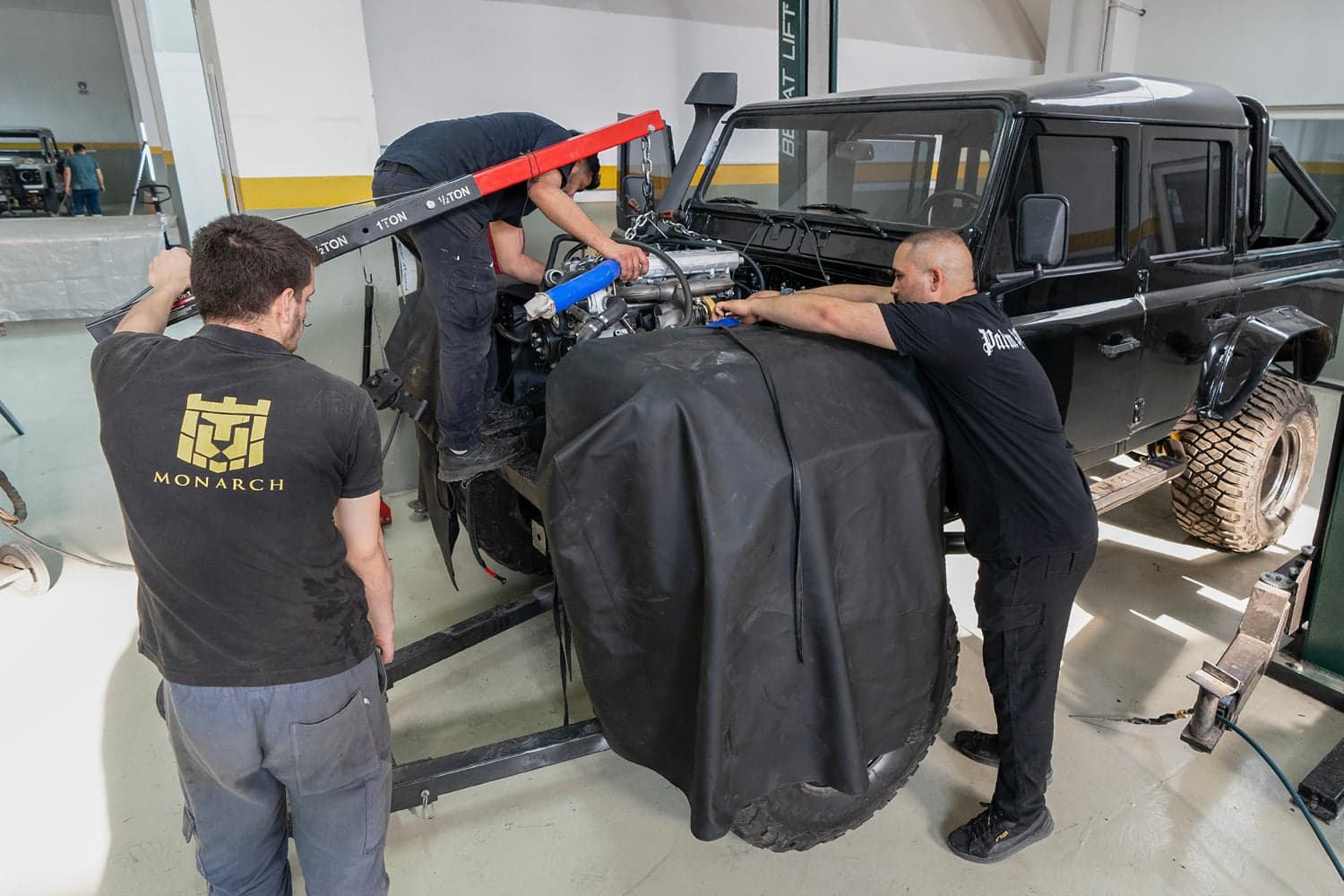
A ground-up commission starts with the chassis. Every Monarch is built on a new KTL-coated, galvanized chassis. The donor we source supplies the identity and title, not the frame. The LT230 transfer case gets completely rebuilt. The permanent 4WD system, the three differentials, the propshafts... actually, let me be more precise. Every driveline component gets inspected, measured against tolerance, and either reconditioned or replaced.
The result is a custom Land Rover Defender that retains the silhouette, the analog driving character, and the permanent four-wheel drive capability that made the original legendary, but wrapped around modern power, modern brakes, a complete new wiring harness, hand-stitched Italian leather, and climate control that actually works.
That last point matters more than people think. The original Defender's heater was basically a suggestion. On a cold morning, you'd wait 20 minutes for the cabin to approach "not freezing." Our builds have proper HVAC and technology.
The 25-Year Import Rule and What It Means for You
If you're in the US and shopping for a 4x4 Defender, the federal 25-year import exemption is directly relevant. Any Defender manufactured 25 or more years ago is exempt from DOT and EPA requirements. As of 2026, that includes models built through early 2001. This has opened the floodgates for European-spec Defenders, including 300Tdi and Td5 variants that were never sold here.
The catch? These trucks arrive with right-hand drive, metric fasteners (mixed with imperial, because Land Rover), and potentially decades of hidden corrosion. A UK Defender that spent its life salted roads in the Cotswolds may look presentable and be structurally terminal.
The NAS trucks, despite their higher price tags, offer US-legal provenance, factory roll cages, left-hand drive, and four-wheel disc brakes that the rest-of-world models didn't get. For a collector, that provenance matters. For a builder, the chassis condition matters more.
Commencing Your Commission
The classic 4x4 Defender Land Rover earned its place through decades of proving itself in conditions that destroy lesser vehicles. The permanent four-wheel drive system, the LT230 transfer case, the coil-sprung live axles... these aren't just specifications. They're the engineering foundation of a vehicle that became synonymous with going anywhere.
A Monarch carries that foundation forward with modern power, modern reliability, and the kind of handcrafted detail that turns a vintage platform into something you'll pass to the next generation. Our 12-stage ground-up build process begins with the chassis and ends with a vehicle that honors 75 years of Land Rover heritage while delivering an experience the original engineers would have envied.
Start your commission today and speak with our build team about creating a 4x4 Defender that's truly yours.