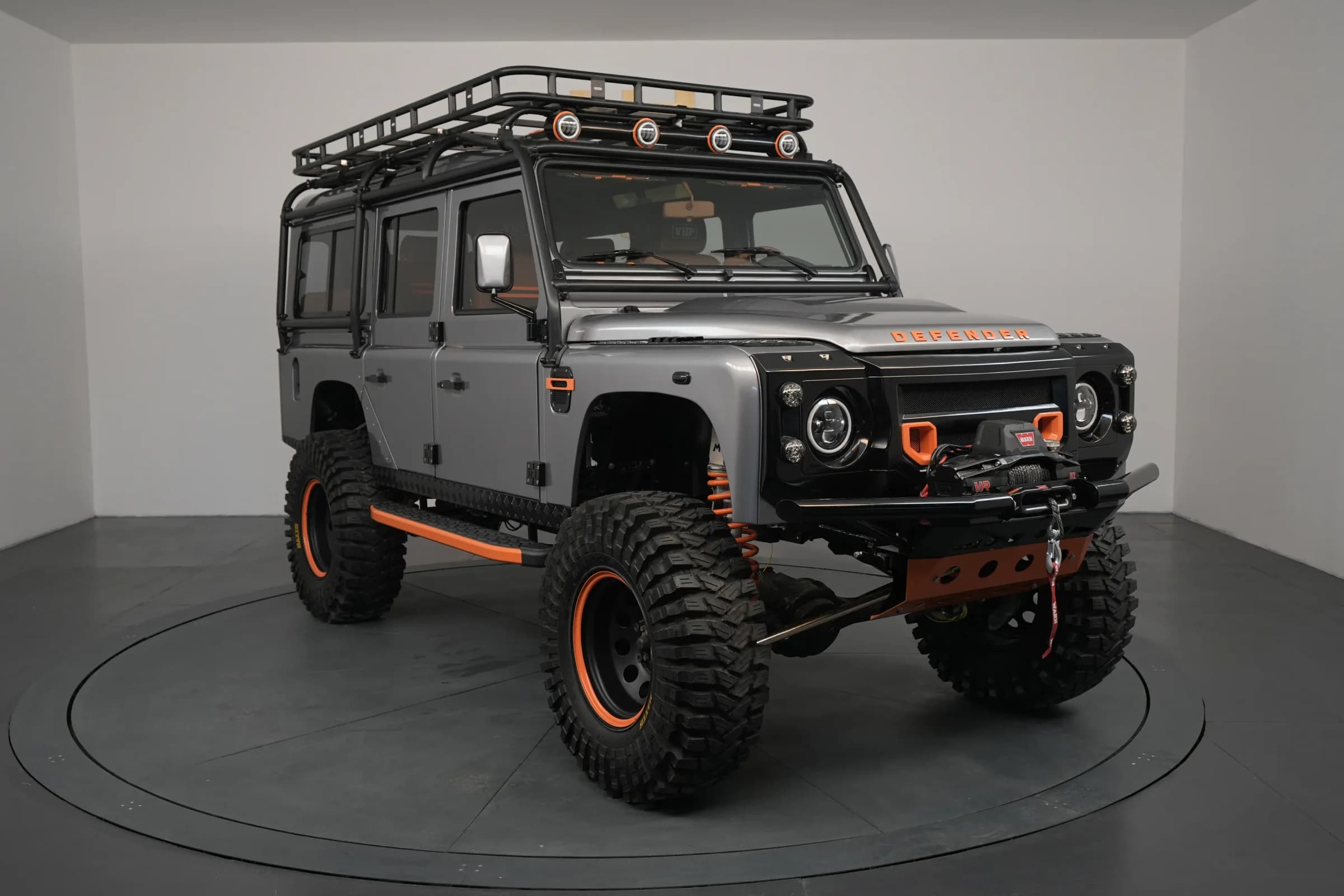
A 300Tdi Idling at a Stoplight Changed My Mind Forever
I remember sitting in a stock 1996 Defender 90 in Atlanta traffic, watching the temperature gauge creep upward while a Camry pulled away from me at the green light. The 300Tdi was clattering along at 111 bhp[1], doing its best. And its best, frankly, wasn't enough.
That was over a decade ago. Since then, I've overseen more than 150 ground-up Defender builds at Monarch, and the single question I field most often from clients is deceptively simple: What's the best engine for a Land Rover Defender restoration?
The answer depends entirely on what you mean by "best." Best for originality? Best for crossing the Sahara with nothing but a toolkit and spare fan belt? Best for merging onto I-95 without praying? Each answer points to a different engine.
So here's what I know, from first-hand experience and hundreds of hours with each of these powerplants.
The Factory Diesel Engines: A Timeline
Before we talk about swaps, you need to understand what Solihull actually bolted under the bonnet over 33 years of production. The progression tells you everything about Land Rover's priorities and, just as often, their compromises.
200Tdi (1990–1994)
The engine that made the Defender drivable. The 200Tdi produced 111 bhp and 195 lb-ft of torque[1], which represented a roughly 25% improvement over the naturally aspirated diesel it replaced[3]. It was one of the first mass-produced, small-capacity direct-injection diesels[2], and it felt like a revolution at the time.
The 200Tdi paired with the LT77 5-speed gearbox. It's purely mechanical. No ECU. No sensors to speak of. If something breaks in the middle of Botswana, a decent mechanic with basic hand tools can sort it.
But here's what the nostalgia crowd won't tell you: the 200Tdi was considered "rather raucous and unrefined"[2] even by 1990s standards, and a special version had to be produced just to fit the Defender[2]. Early units had known head gasket weaknesses. The British Army actually refused to adopt the 200Tdi because it couldn't accept a 24-volt generator for powering radio equipment[2].
Still. For pure simplicity, it's hard to beat.
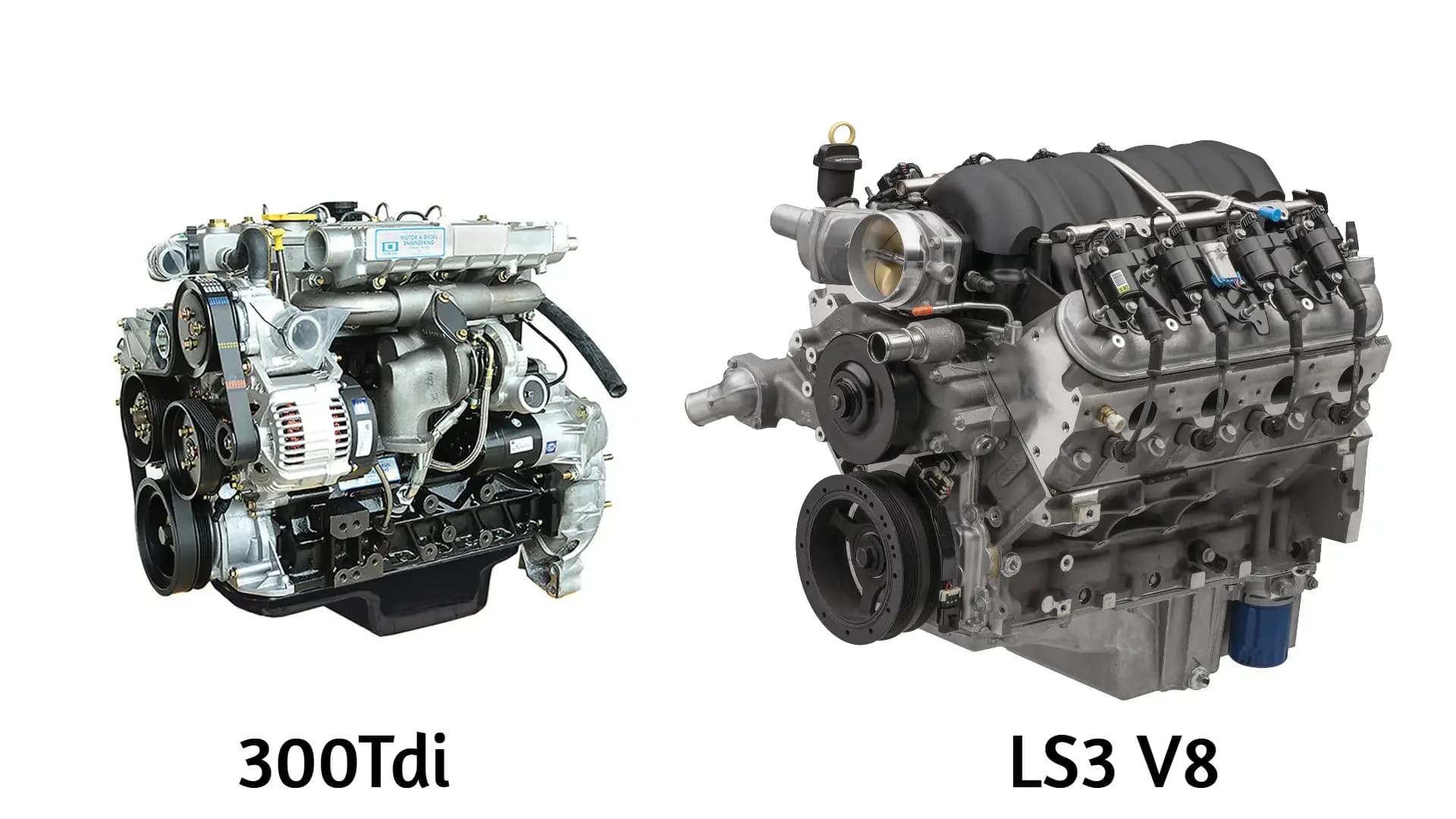
300Tdi (1994–1998)
Developed under the codename "Romulus,"[2] the 300Tdi looked like a mild update on paper. Same bore, same stroke, same 111 bhp and 195 lb-ft[3]. But Land Rover made 208 individual changes to the design[2], and the difference was immediately noticeable.
Quieter. Smoother. A serpentine ancillary drivebelt replaced the multiple belts of the 200Tdi[3]. And the 300Tdi came paired with the R380 gearbox, which is a genuinely better transmission than the LT77 by a wide margin.
The 300Tdi wasn't perfect, though. Early models had a cambelt pulley misalignment that caused some belts to fray and fail[1]. And it was slightly thirstier than its predecessor.
After the Td5 replaced it in 1998, the 300Tdi continued in production for military and overseas Defenders[3]. The armed forces were never convinced by the Td5's electronics and, through special order, kept buying 300Tdi trucks[3]. That tells you something.
Monarch Insight: For overlanding and expedition use, the 300Tdi remains the gold standard among purists. But for a vehicle you'll actually enjoy driving on American roads? You need more power. A lot more.
Td5 (1998–2007)
The Td5 was Land Rover's last in-house diesel engine. Five cylinders, 2,493cc, producing 122 bhp at 4,850 rpm and 221 lb-ft of torque at 1,950 rpm[4]. It used a Lucas Electronic Unit Injection system with a chain-driven camshaft[4], and around 310,000 units were built before production ended[2].
The Td5 is the most misunderstood Defender engine.
Purists hated it because of the electronics. They worried about ECU failures in remote locations. And yes, early engines had two known mechanical issues: sudden oil pump drive failure and "cylinder head shuffle" caused by weak retaining studs[2]. Those were legitimate problems.
But the post-2002 Td5 with the upgraded 15P cylinder head[6] is a genuinely strong motor. With ECU remapping, you can safely push output to 150–180 hp with torque climbing to 300–350 lb-ft[6]. With proper maintenance, a Td5 can surpass 300,000 miles[6].
The Td5 sounds right in a Defender. That five-cylinder warble is distinctive. And it delivered smoother power than the 300Tdi while maintaining strong low-end torque[6].
Ford-Sourced TDCi "Puma" (2007–2016)
The final chapter of factory Defender engines. A Ford Duratorq 4-cylinder in 2.4L (2007–2012) and 2.2L (2012–2016) variants[8]. Output was 122 hp at 3,500 rpm with 265 lb-ft of torque at 2,000 rpm[4], a meaningful jump in low-end grunt over the Td5.
The Puma brought modern common-rail diesel technology and a 6-speed gearbox[8]. It was more refined inside the cabin. But it was a Ford engine in a Land Rover. For many Defender loyalists, that was a bridge too far.
I don't love the Puma for restoration builds. Not because it's a bad engine, mind you, but because it introduced more complexity (DPF, EGR, high-pressure injectors[8]) without solving the fundamental problem: the Defender is still underpowered for modern road use.
Want to learn more about the history of the Land Rover Defender? Check out our blog post explaining the history.
The Original V8: Charming but Outgunned
The Rover 3.5L V8 deserves its own mention. This engine started life as the Buick 215[2], an all-aluminum pushrod V8 that General Motors designed in the late 1950s. Rover bought the tooling and produced the engine from 1967 onward.
In the Defender (and its predecessor), the 3.5L V8 made roughly 114 bhp at 4,000 rpm with 185 lb-ft of torque[4]. Later fuel-injected 3.9L and 4.0L versions bumped that to around 182 bhp and 232 lb-ft[4].
Charming? Absolutely. The sound alone is worth a grin. Adequate for modern traffic? Not remotely.
The Rover V8 had become "uncompetitive with other V8 engines in its class" by the late 1990s[2], producing less horsepower, burning more fuel, and relying on an aging pushrod architecture. I've driven Defenders with the original V8. I've also pushed them up hills in second gear while fully loaded. The experience informs my opinion.
The Engine Comparison Table Every Defender Buyer Needs
Here are the numbers, side by side. No fluff.
| Engine | Years | Displacement | HP | Torque (lb-ft) | Gearbox | Fuel Type | Electronics |
|---|---|---|---|---|---|---|---|
| 200Tdi | 1990–1994 | 2.5L I4 | 111 | 195 | LT77 5-spd | Diesel | None |
| 300Tdi | 1994–1998 | 2.5L I4 | 111 | 195 | R380 5-spd | Diesel | None |
| Td5 | 1998–2007 | 2.5L I5 | 122 | 221 | R380 5-spd | Diesel | ECU |
| TDCi 2.4/2.2 | 2007–2016 | 2.4/2.2L I4 | 122 | 265 | MT82 6-spd | Diesel | Full ECU |
| Rover V8 3.5 | 1983–1998 | 3.5L V8 | 114 | 185 | LT77/R380 | Petrol | Minimal |
| Rover V8 3.9/4.0 | 1994–1998 | 3.9L V8 | 182 | 232 | R380 5-spd | Petrol | EFI |
| GM LS3 | Swap | 6.2L V8 | 430 | 424 | 6L80E 6-spd auto | Petrol | Full ECU |
| GM LT1 | Swap | 6.2L V8 | 460 | 465 | 6L80E 6-spd auto | Petrol | Full ECU |
Sources: Rovers North specifications document[4], Land Rover Monthly[1], GM Authority[5]
Look at that table for a moment. The jump from 122 hp (Td5) to 430 hp (LS3) isn't incremental. It is a different category of vehicle.
Which V8 Swap is Better for a Defender: LS3 or LT1?
This is where the conversation gets real for anyone commissioning a serious build.
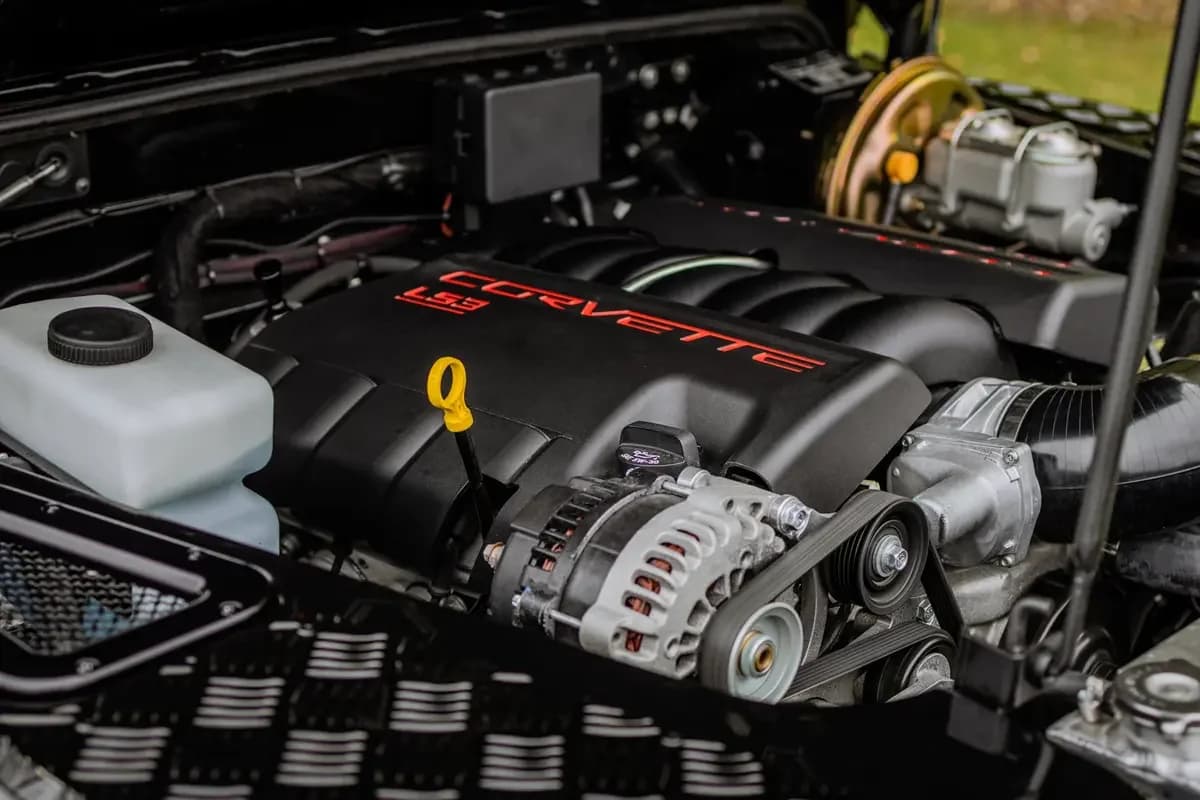
The General Motors (GM) LS3 6.2L V8 crate engine is a naturally aspirated V8 producing 430 hp and 424 lb-ft of torque. It's the same engine found in the Chevrolet Corvette and Camaro SS, and it has become, without exaggeration, the most popular swap engine for classic Defenders worldwide. The LS3 crate motor ships ready to mate with the 6L80E 6-speed automatic transmission[5], and GM backs it with a 2-year/50,000-mile limited warranty.
The GM LT1 is the Gen V evolution. Same 6.2L displacement, but with direct injection, continuously variable valve timing, and Active Fuel Management[5]. Output climbs to 460 hp and 465 lb-ft of torque[5] with the compression ratio rising to 11.5:1.
So which one do we install at Monarch? Both. And the choice depends on the client.
The LS3 is simpler. Port injection means fewer high-pressure fuel system components. Servicing is straightforward; any performance shop in America can work on an LS3 with their eyes closed. The aftermarket support is everywhere.
The LT1 is more advanced. Direct injection delivers better fuel atomization and the Active Fuel Management system can deactivate four cylinders during light-throttle cruising. On a long highway run, you'll notice the difference in fuel economy. The trade-off is marginally more complexity in the fuel delivery system.
At Monarch, our recommendation: For clients who prioritize simplicity and broad serviceability, the LS3 is the smarter choice. For clients who want peak performance numbers and modern efficiency features, the LT1 delivers. Both engines transform the Defender from a lovable relic into a vehicle that can genuinely keep pace with anything on the road.
Here's a detail that only matters if you've actually done the install: the LT1's direct injection fuel pump is driven off a trilobe on the camshaft[5]. When we're setting up the engine bay, we have to account for the high-pressure fuel line routing and the additional space the pump occupies on the front of the engine. It's not a dealbreaker, but it adds two to three hours to the installation compared to an LS3 swap. Small stuff. The kind of thing you'd never read about on a forum.
Why the Stock Diesel Doesn't Cut It Anymore
The 300Tdi and Td5 are good engines. Reliable. Characterful. Historically significant. But the classic Defender weighs roughly 4,000 lbs, and shoving 111–122 hp through that mass produces a vehicle that, on American highways, is legitimately dangerous in certain merge situations.
The last stock Defenders took nearly 15 seconds to reach 60 mph[7]. That is not a typo. Fifteen seconds.
Even Land Rover's own Classic division recognized this problem. Their factory-restored Classic Defender V8 now ships with a 5.0-liter Jaguar V8 producing about 405 hp[7], paired with an 8-speed automatic. And they're charging £195,000 before taxes for the privilege[7]. That's roughly $260,000.
So the manufacturer itself is telling you: the stock drivetrain is insufficient. The question is just which modern V8 you choose and who installs it.
Choosing the Best Engine for Your Defender Restoration: A Decision Framework
Forget the forum debates. Here is how to actually think about this.
If your goal is museum-quality preservation: Keep the original engine. A numbers-matching 300Tdi or Td5 in a documented truck adds collector value. Don't touch it.
If your goal is solely expedition and overlanding: The 300Tdi wins on pure field-repairability. No electronics, common parts globally, and the mechanical injection system will run on almost anything combustible. The armed forces agreed[3].
If your goal is a usable, daily-drivable vehicle: A modern V8 swap is not optional. It is the only path to a Defender that performs like the $150,000+ vehicle the market says it is.
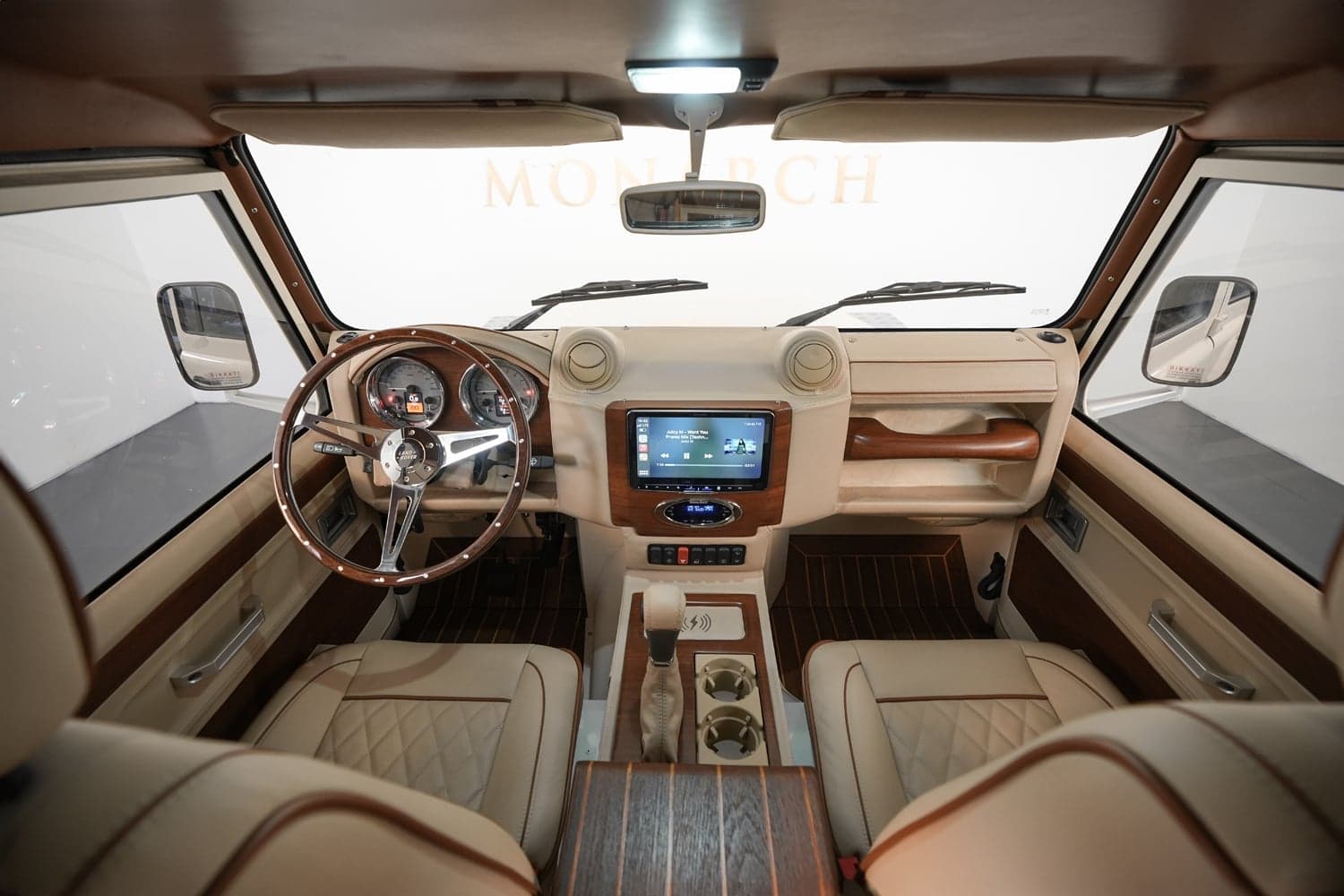
If your goal is the best of both worlds, heritage aesthetics with modern capability: This is what we build at Monarch. A ground-up commission where the chassis is stripped, galvanized, and fitted with a new GM LS3 or LT1, a modern 6-speed automatic, upgraded brakes, climate control, and a hand-stitched Italian leather interior. The outside looks like 1995. The driving experience is 2026.
Builder's Note: The single most common mistake I see is clients who spend $30,000 on a donor vehicle and then try to "improve" the stock engine with a remap and bigger turbo. You'll spend $8,000–$12,000 to gain maybe 30 hp. Or you can do the job properly and gain 300+ hp with better reliability. The math is not close.
What About the Cummins R2.8? The BMW Diesel? Other Swaps?
I get asked about alternative swaps constantly. The Cummins R2.8 turbo diesel (161 hp, 310 lb-ft[6]) is a solid engine and Cummins offers it as a crate motor specifically for conversions. For someone who absolutely must have diesel, it is the best modern option.
But 161 hp in a 4,000-lb truck is still underwhelming. You are spending serious money on a swap to remain slow. Not quite as slow. But slow.
The BMW M57 inline-6 diesel has its advocates, particularly in Europe. Tuned examples can produce north of 300 hp. But parts sourcing, wiring integration, and long-term support are all more complicated than a GM crate motor that ships complete with a factory harness and calibrated ECU.
At Monarch, we've standardized on the GM LS3 and LT1 for a reason. The parts supply chain is the deepest in the automotive world. Any mechanic in any town in America can service them. And the power-to-reliability ratio is, in my experience across hundreds of builds, unmatched.
How Much Does it Cost to Maintain a Stock Defender Engine vs. a V8 Swap?
Here's something most buyers don't calculate: the ongoing maintenance cost of a 30-year-old diesel engine versus a new GM crate motor.
A 300Tdi with 150,000 miles will need, at minimum, a timing belt service, water pump replacement, injector rebuilds, and almost certainly rear main seal work. The turbo may need reconditioning. The injection pump will eventually need a specialist. These components are getting harder to source, not easier, and specialist labor rates for British diesels are climbing.
A new GM LS3 crate engine arrives with zero miles and a factory warranty. The service intervals are standard. The parts are available at every auto parts store in the country. An oil change uses a filter that costs $8.
The initial investment in a V8 swap is higher. But over a 10-year ownership horizon, the total cost of ownership often favors the new engine. I have the service records across our client fleet to prove it.
Commencing Your Commission
The best engine for a Land Rover Defender restoration is the one that matches your intent. For a museum piece, keep it stock. For an expedition rig, the 300Tdi earns its reputation. For everything else, a modern GM V8 is the answer, and the LS3 or LT1 paired with a 6-speed automatic is the specific answer that 150+ Monarch builds have validated.
A Monarch Defender is more than a vehicle; it is a legacy built from bare metal. Our 13-stage ground-up build process is reserved for those who refuse to compromise between heritage and performance. Start your commission today and speak directly with our build team about the right engine for your vision.