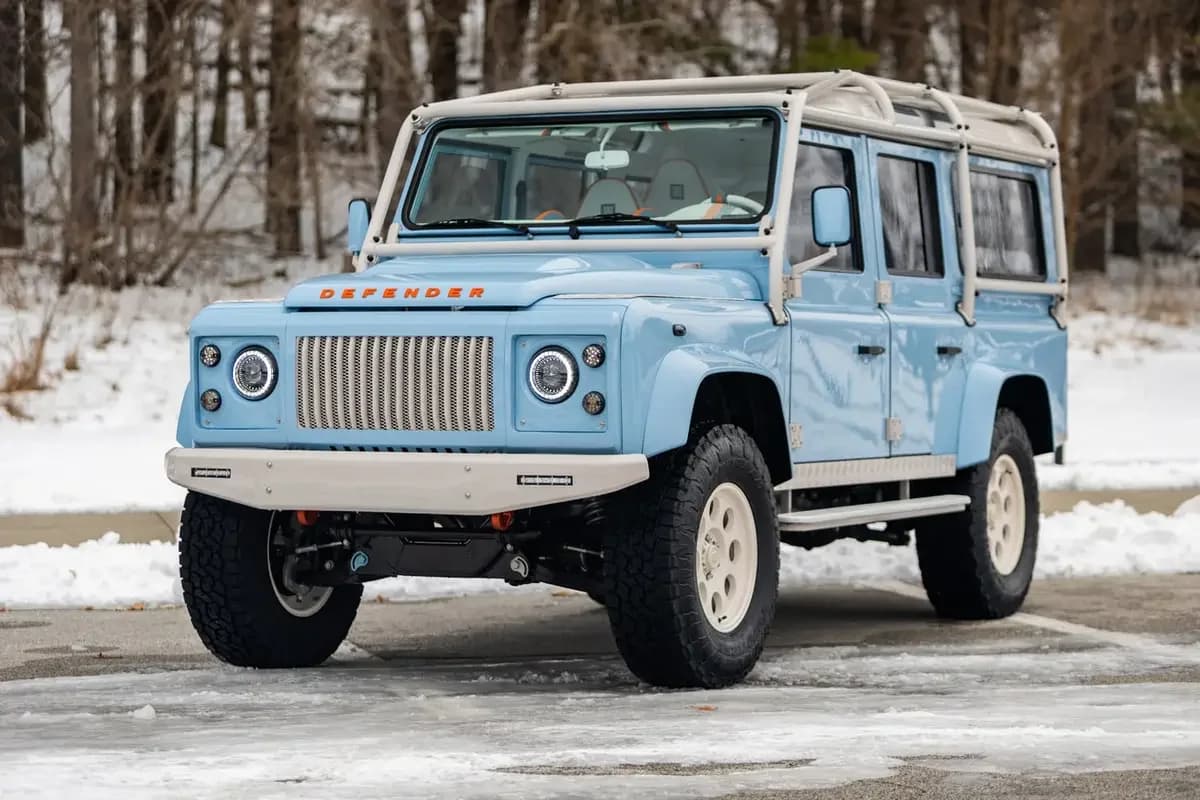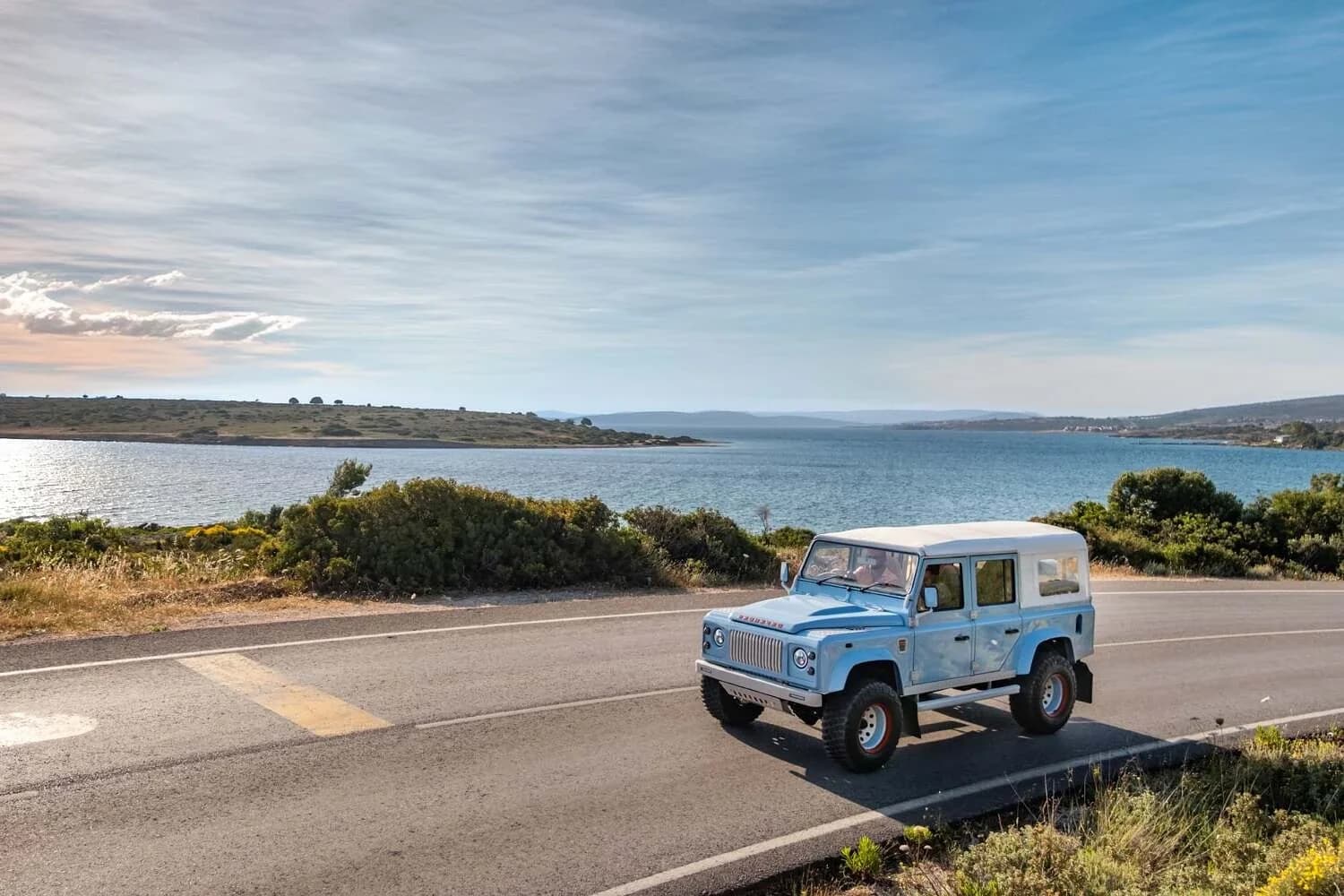
The Quick Answer: Can you daily drive a classic Defender? Yes, you can daily drive a classic Defender, but the experience depends heavily on the build. A stock classic Defender (like a 300Tdi) is slow, lacks modern climate control, and requires a tolerance for a raw, noisy ride. However, a professionally built Defender restomod (featuring an LS3 engine swap, upgraded suspension, and modern wiring) by a company such as Monarch Motor Company transforms the classic silhouette into a reliable, comfortable daily driver capable of highway speeds and modern traffic demands.
Can You Daily Drive a Classic Defender? (The Short Answer)
"Can I daily drive this thing?"
I hear it from every second client who walks through the doors at Monarch. They're standing next to a stripped chassis, galvanized and gleaming under the shop lights, and they genuinely want to know if the truck they're about to commission will work as a Monday-through-Friday vehicle. Not a garage queen. Not a trailer-fed weekend toy. A real, honest-to-God daily driver.
The answer is yes. With a big, fat asterisk.
Because the distance between a bone-stock 1996 Defender 110 and a ground-up restomod built at our shop is about the same distance between a covered wagon and a Cadillac. Same silhouette. Entirely different machine.

Daily Driving a Stock Classic Defender: Expectations vs. Reality
A factory 300Tdi Defender rolls off the line (well, it rolled off the line, past tense, since production ended in January 2016) with a 2.5-liter turbocharged diesel producing 111 hp at 4,000 rpm and 195 lb-ft of torque at 1,800 rpm[1]. That's it. 111 horses pulling roughly 4,200 pounds of British aluminum and steel through a 5-speed R380 manual gearbox[1].
In perspective, a 2026 Honda Civic makes 150 hp. Your Defender, the truck you want to merge onto I-95 in, makes less power than a base-model economy sedan.
The 0-60 time? Nobody measures it. Nobody wants to know.
Solid beam axles front and rear give you the ride quality of, well, a vehicle that was designed to cross the Serengeti at 25 mph, not glide down the Garden State Parkway at 70. The steering is recirculating ball, meaning there's a quarter-turn of dead space at the wheel before the front tires even think about changing direction. Wind noise through the door seals is a constant companion. The heater works, but calling it "climate control" would be generous. The seats were apparently designed by someone who believed comfort was a moral failing.
And yet people daily drive these things all over the planet. They have for decades. Classic Defenders are still in active service with aid organizations and military units across six continents[7]. An estimated two-thirds of all Defenders and their Series predecessors remain on the road today.
Why? Simplicity.
What Actually Breaks (And What Doesn't)
Here's where most people get the story wrong. The Land Rover "unreliability" reputation belongs to the Discovery and the Range Rover, trucks that got loaded with electronic gadgetry from the late 1980s onward. Those early systems were, frankly, terrible. And they tarred the entire brand.
The classic Defender is a different animal.
The 300Tdi runs on mechanical fuel injection[6]. No ECU. No engine management computer. No oxygen sensors, no catalytic converter drama, no electronic throttle body that decides to randomly act up. If the engine starts, it runs. If it runs, it will keep running until you forget to change the oil or let the timing belt skip past its replacement interval.
Common issues on a daily-driven classic Defender? Oil leaks. Every classic Defender leaks oil. It's almost a feature at this point, a marking of territory. Wiring degradation on trucks older than 25 years, which can cause phantom electrical faults, dim headlights, and the occasional failure to start[7]. Suspension bushings that wear out and introduce slop into the handling. And rust on the chassis, which is the real killer, the one that sends trucks to the scrapper.
The annual maintenance cost for a classic Defender 90 runs approximately $675 per year, according to RepairPal estimates[3]. That's less than a Toyota 4Runner. Dramatically less than a modern Range Rover. Parts are widely available through aftermarket suppliers, and a competent mechanic with basic hand tools can handle most repairs without proprietary diagnostic software.
The 300Tdi engine had 208 engineering changes over the 200Tdi it replaced[6], and both designs share a lineage stretching back to the original Land Rover four-cylinder of 1957. Over 1.2 million engines in this family were built[6]. This is not a rare, exotic powerplant. Spares exist. Knowledge exists. YouTube tutorials exist.
Monarch Standard Note: The single biggest threat to daily-driving a classic Defender is not the engine or gearbox. It's the chassis. A corroded frame is a safety hazard and a structural time bomb. That is why every Monarch is built on a new KTL-coated, galvanized chassis. The donor we source supplies the identity and title, not the frame.
Fuel Economy: Where Diesel Wins and V8s Hurt
The Tdi-powered Defenders are, perhaps surprisingly, not terrible on fuel. The 200Tdi and 300Tdi engines return roughly 24-28 MPG under normal driving conditions. For a body shaped like a refrigerator riding on 33-inch tires, that's honestly respectable. Better than a new Jeep Wrangler, for what it's worth.
The NAS-spec V8 trucks from 1994-1997? Entirely different math. The 3.9-liter Rover V8 manages real-world fuel economy of about 12-14 MPG, and that is on a good day with highway driving and a light throttle foot. Around town, you're genuinely watching the fuel gauge move in real time.
So if daily driving costs matter to you, and you're looking at a stock classic, the diesel is the obvious choice. The V8 sounds better. But your wallet won't thank you.
However, if you were to get a ground-up Monarch from Monarch Motor Company, you could get the best of both worlds. Check out our engine comparison guide to learn more!
Why a Defender Restomod is the Ultimate Daily Driver
Now we get to the part where the conversation shifts.
Because a properly built restomod Defender isn't just daily-drivable. It is genuinely, honestly pleasant to drive. Every single day. I'm not saying that as a sales pitch. I'm saying it because I've overseen ground-up Monarch builds since 2016, and the difference between a stock Defender and one of our completed builds is so dramatic that they barely qualify as the same vehicle.
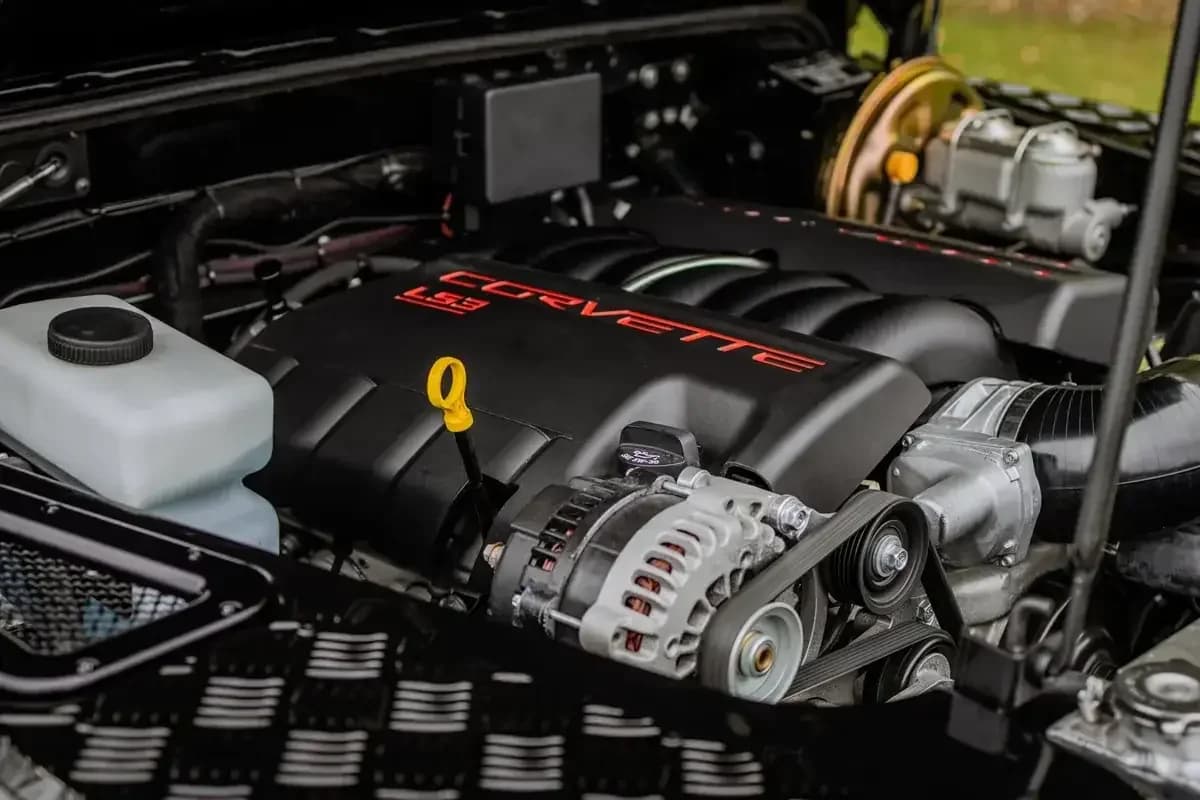
At Monarch, we build with the GM LS3 (6.2L V8, about 430 hp, 424 lb-ft), LT1 (6.2L V8, about 460 hp, 465 lb-ft) or supercharged LT4 (650 hp) through a modern 6-speed automatic transmission, and we also offer EV builds. The gap between 111 horsepower and 430 is not incremental. It is generational. You go from praying during a highway on-ramp to merging with the confidence of a modern luxury sedan.
But power is only half the story. Actually, power is maybe a third. The things that transform a classic Defender from an "experience" into a daily driver are the boring details nobody talks about at car shows:
- A complete new wiring harness. No more 30-year-old Lucas Electrics randomly deciding your brake lights are optional.
- Modern climate control. Proper A/C with R-134a refrigerant and a heater that actually heats. The factory system was inadequate.
- Upgraded disc brakes all around. Stock Defender braking is terrifying by 2026 standards. We replace everything.
- Heavy-duty suspension with road-biased tuning. The truck still rides on solid axles, but modern dampers, progressive-rate springs, and polyurethane bushings turn the ride from punishing into firm-but-comfortable.
- Power steering. Non-negotiable for city driving.
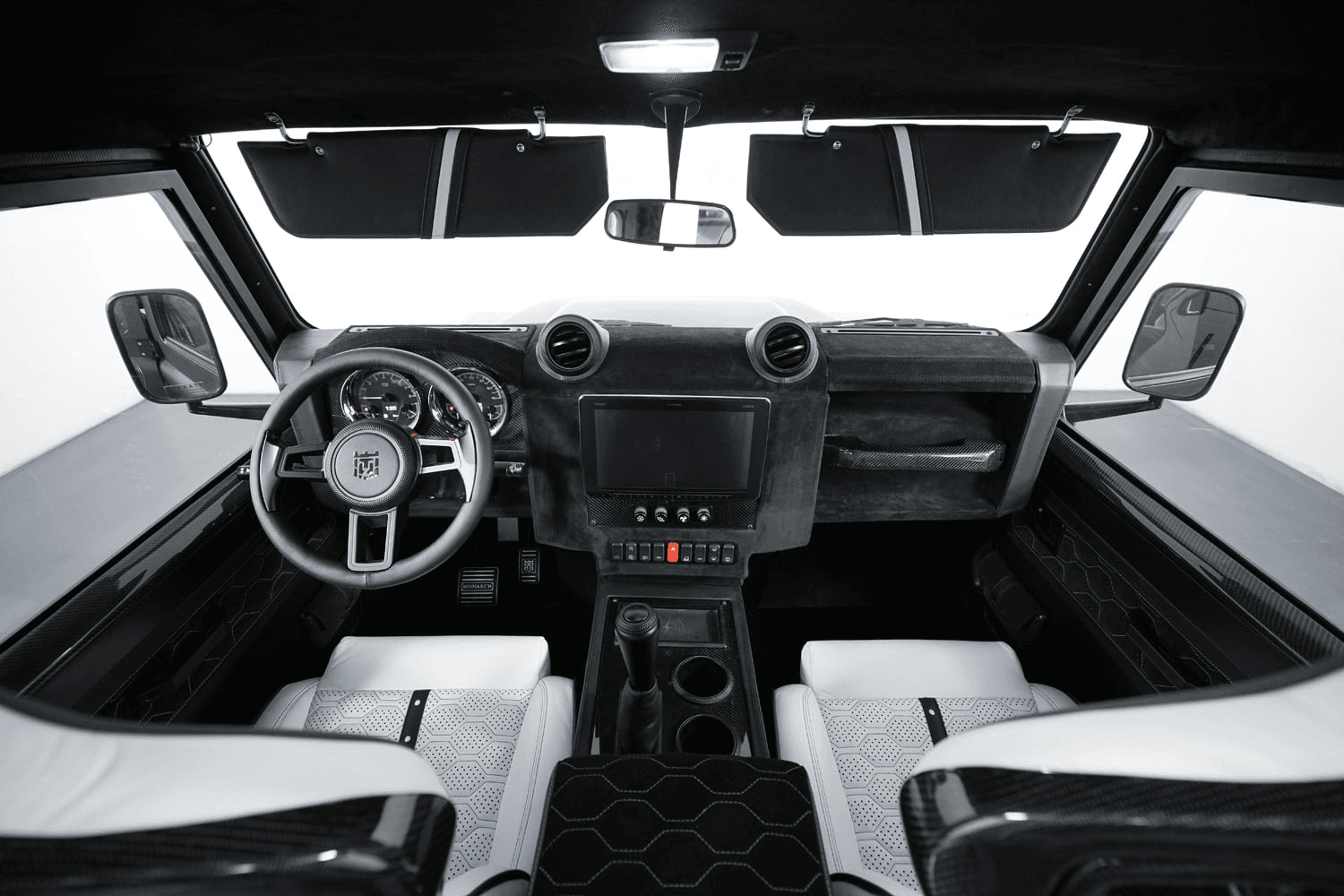
- Sound deadening and a hand-stitched Italian leather interior. Your 45-minute commute shouldn't feel like a military exercise.
The first time I heard an LS3 turn over in a Defender chassis, I stood there grinning like an idiot. That was build number three or four. A decade of builds later, I still smile. Every single time.
What We've Learned Since 2016: The most common feedback from clients who commission daily-driver specs is surprise at how normal the truck feels in traffic. They expected a project vehicle. What they got was a truck that happens to look like a 1995 Defender but drives like it was engineered this year.
Stock Defender vs. a Monarch Restomod
| Feature | Stock Classic Defender (e.g., 300Tdi) | Monarch Restomod Defender |
|---|---|---|
| Power & Merging | 111 hp (Slow highway merging) | 430+ hp (Modern highway capability) |
| Fuel Economy | 24-28 MPG | 14-18 MPG |
| Climate Control | Inadequate factory heater/AC | Modern HVAC with R-134a |
| Reliability | Mechanical simplicity, prone to oil leaks | Modern wiring harness, highly reliable |
| Comfort | Loud, rigid, agricultural ride | Sound-deadened, custom suspension |
The Investment Question: Will Daily Driving Destroy the Value?
Understandablly, people worry about this.
The highest recorded sale for a NAS Defender 90 Hard Top reached $212,800 in November 2025[5]. Average sale prices for NAS D90 Soft Tops sit around $78,340. These are not cheap trucks. Should you be daily driving an appreciating asset?
It depends, an unrestored, low-mileage, original-paint NAS Defender in concours condition? Do not daily drive it. That's a museum piece. It belongs in a climate-controlled garage with a battery tender and an insurance policy that makes your accountant wince.
A professionally executed restomod? Drive it. That's the entire point.
A galvanized chassis does not corrode. A new wiring harness does not degrade like 30-year-old copper. Modern brake components do not fade. And a well-documented, ground-up build actually holds value better when it has some miles on it, because those miles prove the vehicle works as intended. A restomod with 5,000 miles on the clock tells the next buyer "this build was validated on real roads." A restomod with zero miles tells them nobody trusted it enough to turn the key.
I've seen poorly modified Defenders, the kind with backyard LS swaps and no documentation, lose half their value in three years. And I've seen properly documented ground-up builds appreciate 15-20% in the same period. The difference is not whether you drive them. It is how they were built.
The Practical Daily-Driver Spec
If you're commissioning a Defender specifically for daily use, here is what I'd specify after a decade of ground-up builds:
| Component | Recommended Spec |
|---|---|
| Body Style | Defender 110 (four doors, real passenger space) |
| Engine | GM LT1 6.2L V8, 460 hp, 465 lb-ft |
| Transmission | 6L80E 6-speed automatic |
| Suspension | Heavy-duty, road-biased valving |
| Interior | Full leather, modern HVAC, quality audio, USB |
| Lighting | LED headlights with proper beam pattern |
| Chassis | New KTL-coated, galvanized chassis |
The D90 is the icon. Better proportions. More desirable. But the D110 is the superior daily driver because you can fit actual humans in the back seats and their gear behind them. If your daily involves kids, dogs, or any cargo larger than a gym bag, go with the 110.
Check out our Defender 90 vs 110 vs 130 comparison guide to learn more.
Classic Defender Maintenance Costs & Reliability as a Daily
One thing classic Defenders have over virtually every other vintage truck on the road: parts availability is enormous. The Td5 engine alone had 310,000 units produced between 1998 and 2007[6]. The 300Tdi production line ran continuously from 1994 until 2006[6]. These are not obscure engines with unobtainium gaskets.
More than two million Series Land Rovers and Defenders were built at Solihull over a 68-year production run[2]. Each one took approximately 56 hours to hand-build[2]. That long production history means an aftermarket ecosystem that is deep and well-established.
And for a restomod with a GM LS3 or LT1? Any Chevrolet dealer in America stocks the parts. Try getting same-day service for your vintage Porsche daily driver.
At Monarch, we torque every transfer case mounting bolt to spec using calibrated tools, and we document our builds. That documentation is not just quality control. It's your build's provenance, and ten years from now, it's what separates your truck from a mystery-history project on Craigslist.
Commencing Your Commission
Can you daily drive a classic Defender? Stock, yes, with real compromises, a tolerance for agricultural road manners, and a genuine love for the raw driving experience. As a properly built restomod, absolutely, with modern power, modern brakes, working climate control, and the kind of presence that turns every parking lot into a car show.
A Monarch is built once, from the ground up, for one owner. No client vehicles. No parts sales. No shortcuts. If you're ready for a classic Defender that works as flawlessly on your Wednesday commute as it does on a fire road in Montana, start your commission today and speak directly with our build team. We'll walk you through donor selection, powertrain options, and every detail from paint codes to leather grain.
The waiting list exists for a reason.