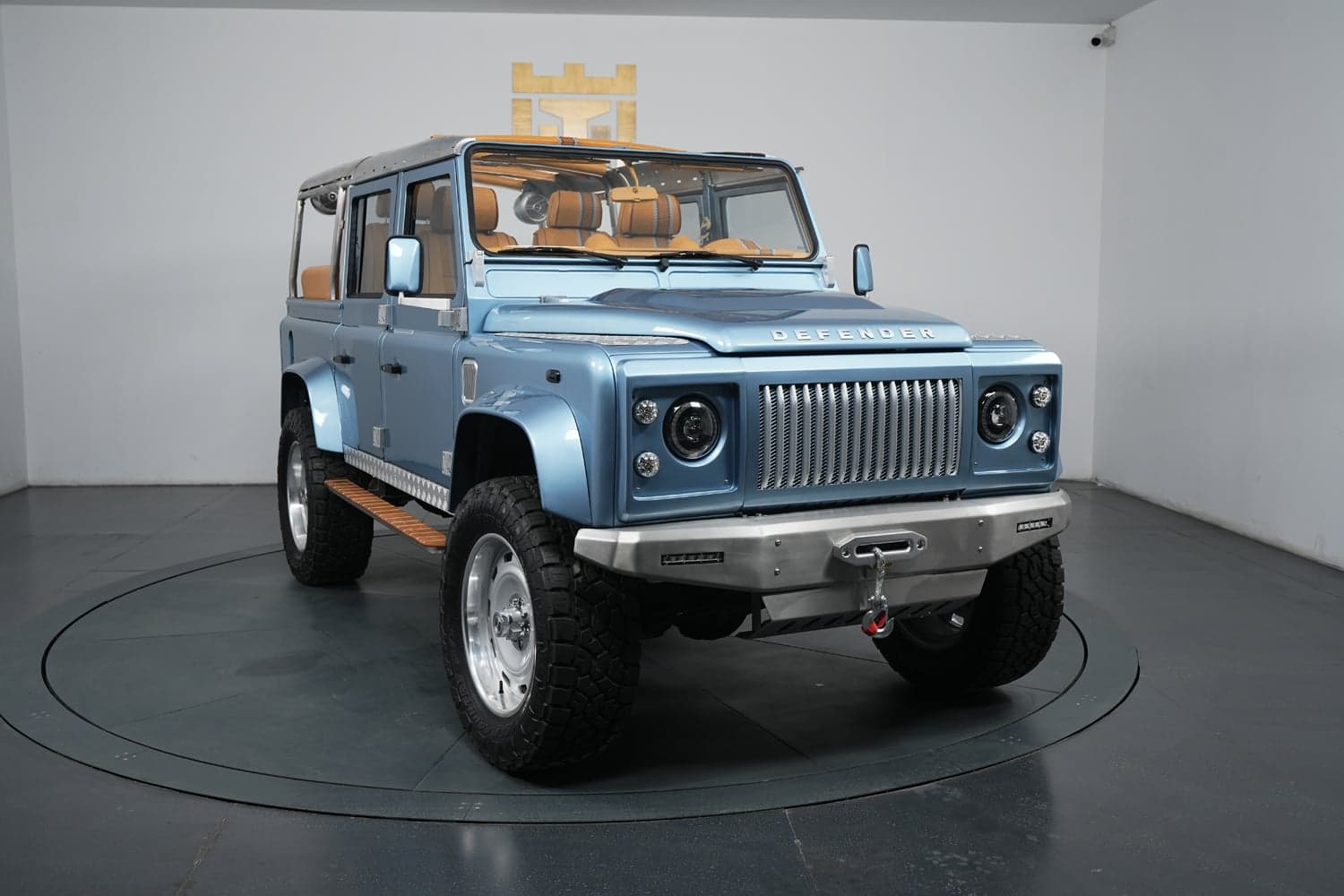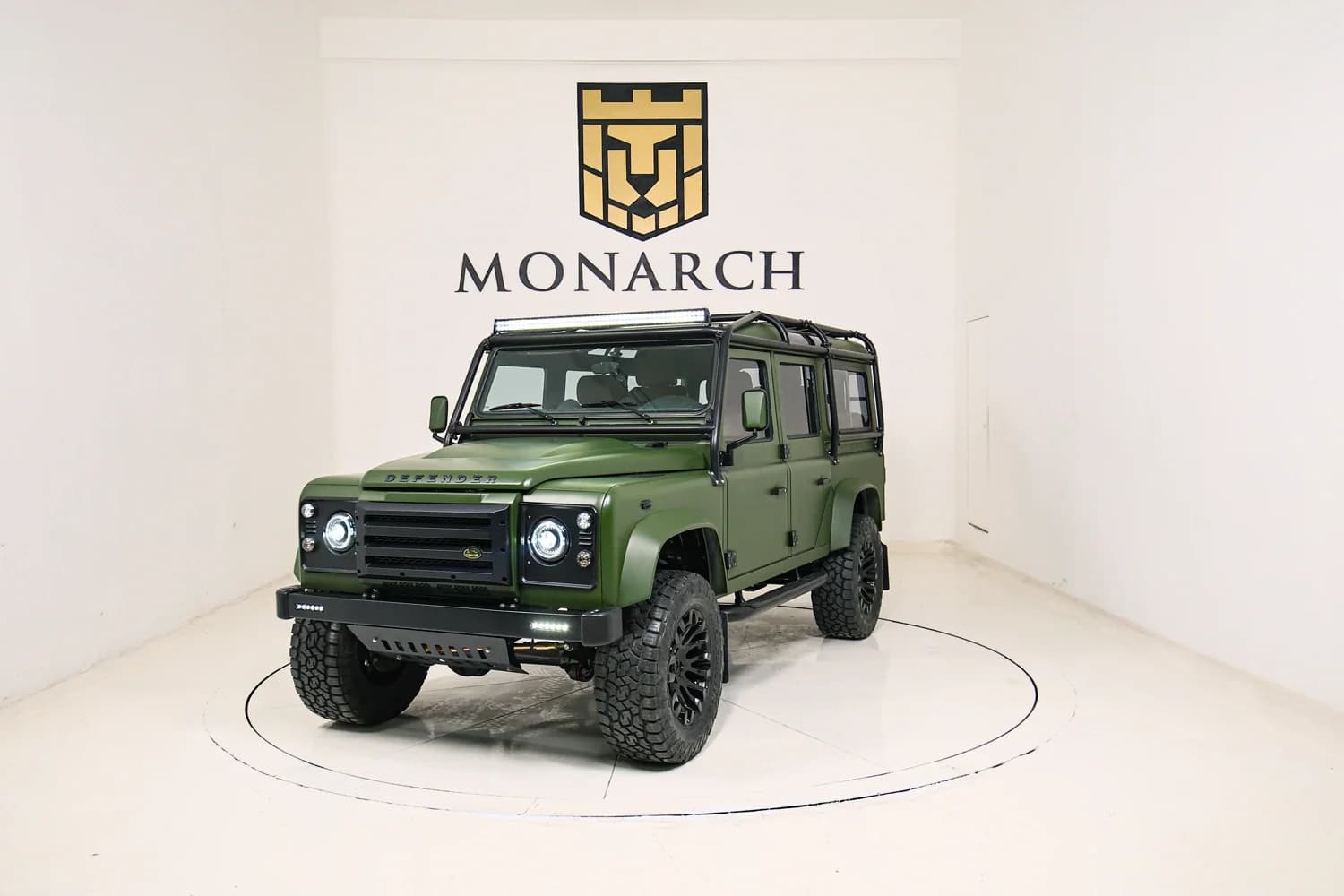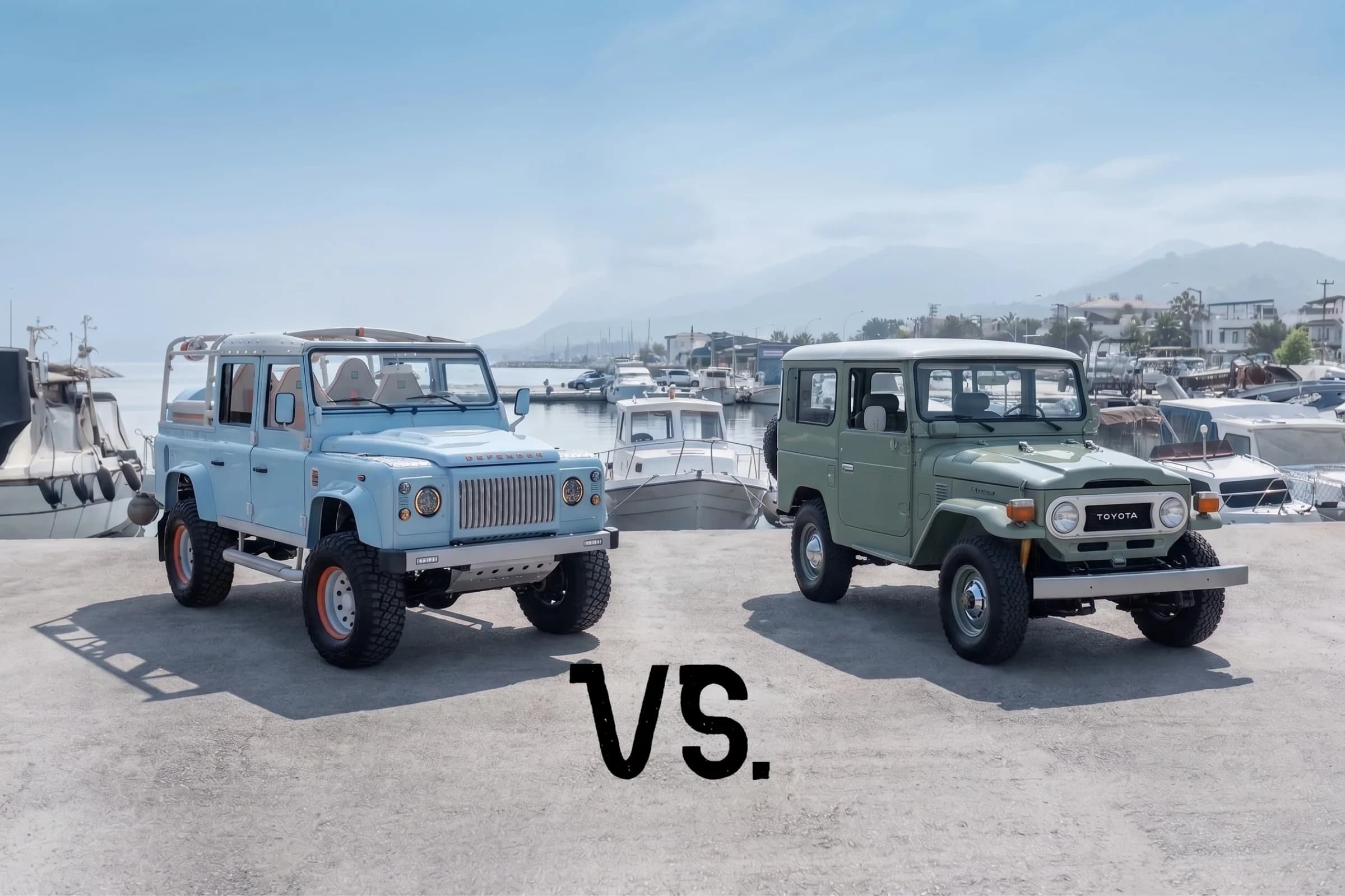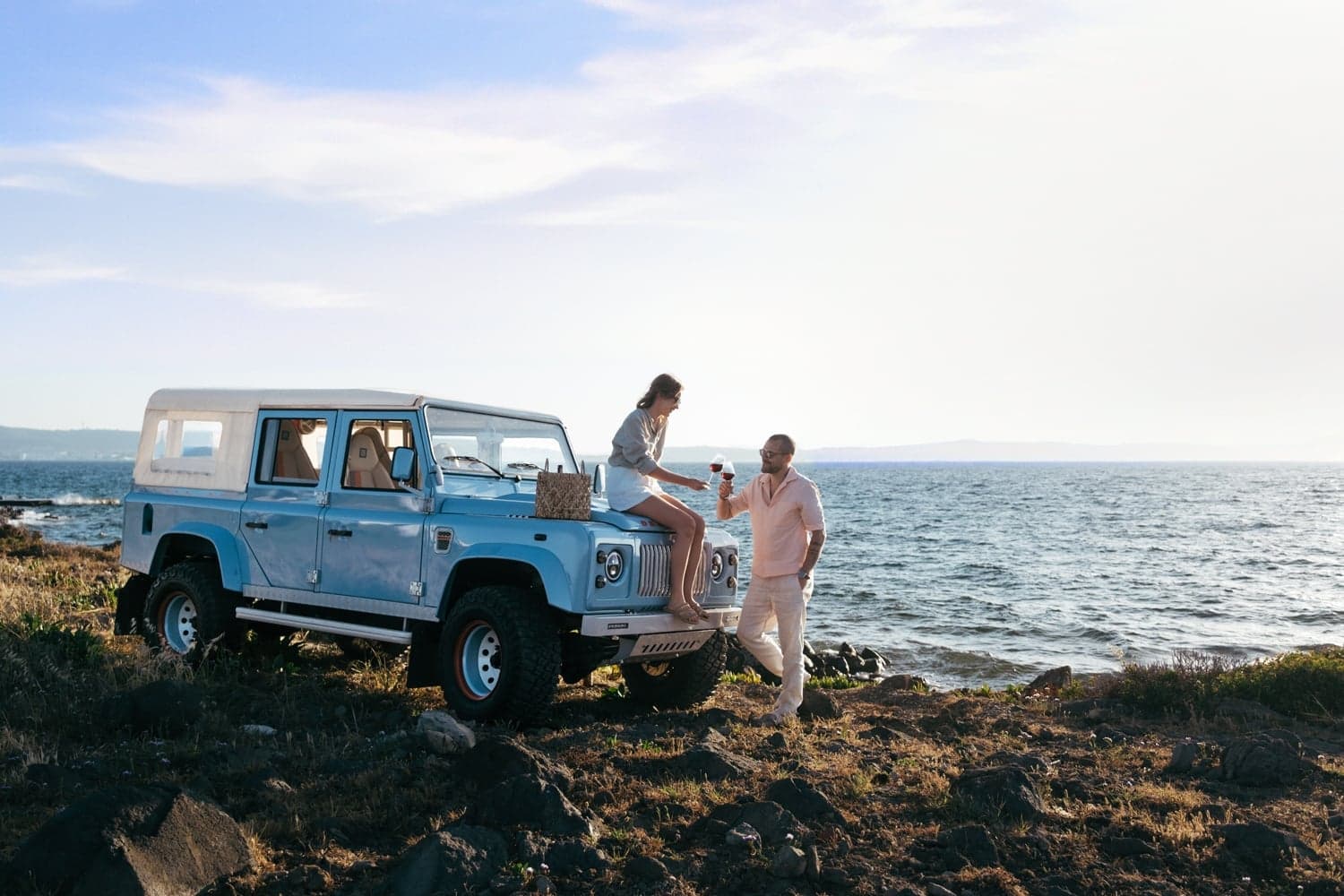
The classic Land Rover Defender is more than just a 4x4; it is a globally recognized automotive icon. Born from rugged utility, the vintage Defender has evolved into a highly sought-after luxury asset for collectors and enthusiasts alike. But for today's driver, preserving that iconic heritage doesn't mean you have to settle for vintage, agricultural performance. At Monarch Motor Company, we specialize in high-end, bespoke restorations that marry the timeless aesthetic of the classic Defender with the thrilling reliability of modern V8 power. Whether you are looking into the investment value of a custom build or exploring the unmatched driving experience of an LS-swapped Defender 90 or 110, here is everything you need to know about the ultimate heritage vehicles.
I've built more than 150 of these trucks from the frame up at Monarch, and the question I get asked most isn't about engines or paint codes. It's this: What exactly makes the classic Defender worth this kind of money?
Good question. Let me try to answer it properly.

The Heritage: From Utility Vehicle to Classic Automotive Icon
The origin story is almost too good. Maurice Wilks, Rover's chief engineer, drew the outline of a utility vehicle in the sand at Red Wharf Bay, Anglesey, in 1947[1]. A year later, the completed Land Rover debuted at the Amsterdam Motor Show. It was designed to work farms, haul loads, and survive conditions that would kill most machines. The British Army ordered its first batch by 1949.
Production of the model now known as the Defender began in 1983 as the Land Rover One Ten, named for its 110-inch wheelbase[1]. The Ninety, with its 92.9-inch wheelbase, followed in 1984[1]. These replaced the leaf-sprung Series III with coil springs, permanent four-wheel drive, and disc brakes up front. It was a proper generational leap.
But here's the thing people forget: the truck wasn't called a "Defender" until 1990. Land Rover introduced the Discovery that year and needed to differentiate the models, so the 90 and 110 got the Defender badge[1]. The name stuck. Permanently.
After a continuous run of 67 years, production ended on January 29, 2016, with just over two million Land Rover Series and Defender models built[1]. The last truck carried the plate H166 HUE, a nod to HUE 166, the registration of the very first pre-production Land Rover.
Two million trucks. One basic shape. Nearly seven decades. No other single-generation vehicle comes close to that kind of production longevity.
Why the Classic Land Rover Defender is a Prime Investment
Let me be blunt. There are prettier trucks. There are faster trucks. There are trucks that don't leak from every gasket when you park them on a slope.
But the Defender's value proposition has never been about perfection. It's about character, provenance, and a finite supply that gets smaller every year as unrestored examples rot away in fields.
The numbers paint a clear picture. In the early 2000s, a classic Defender 90 or 110 could be picked up for $15,000 to $20,000. Today, properly restored examples command $100,000 or more, with top-tier restomod builds regularly exceeding $250,000. That's a threefold to sevenfold increase in roughly two decades.
NAS Defenders, the North American Specification models sold in the US from 1993 to 1997, sit at the top of the market. Only about 7,059 were ever produced for the American market[1]. The average sale price for a NAS Defender 90 Soft Top currently sits at $78,340[3], but clean, low-mileage examples shatter that figure regularly. A 1997 NAS Defender 90 Hard Top brought $212,800 at auction in November 2025[2].
Why? Scarcity. US-legal provenance. The factory roll cage. And a cult following that shows no sign of cooling off.
Monarch Standard Note: Provenance and documentation can increase a classic Defender's market value by up to 30%. Every Monarch build ships with complete build documentation, photographic records, and certification of every component used.
The broader classic car market supports this trajectory. Hagerty CEO McKeel Hagerty told CNBC that auctions and online sales of collectible cars surged 10% in 2025 to $4.8 billion[5]. A new generation of collectors, spanning Gen X through Gen Z, is redefining demand[5], and the Defender's analog honesty is exactly what many of these younger buyers are looking for.
Modern Performance: The Power of a V8-Swapped Defender
Ask ten Defender enthusiasts which engine is best and you'll get twelve opinions. But after tearing down, inspecting, and replacing hundreds of these powerplants, I have my own take.
The 300Tdi (1994–1998): The People's Champion
The 300Tdi is a 2,495cc inline-four, direct-injection turbo diesel producing 111 hp at 4,000 rpm and 195 lb-ft of torque at 1,800 rpm[4]. Those numbers look laughable next to modern engines. They aren't.
What the 300Tdi offers is mechanical simplicity that borders on the philosophical. No ECU. No electronic injection. A mechanical fuel pump you can rebuild in a parking lot in Namibia with basic hand tools. The British Army, mind you, demanded Land Rover keep the 300Tdi in production even after the Td5 was introduced because they didn't trust the electronic engine management in field conditions[4]. That should tell you something.
The 300Tdi was paired with the R380 gearbox starting in 1994, which was itself a marked improvement over the LT77 it replaced. Smoother shifts, better synchros, and stronger internals for handling the diesel's torque curve.
Is it the best engine Land Rover ever put in a Defender? For a stock truck intended for remote work or overlanding, absolutely. Full stop.
The Rover V8 (NAS Models, 1993–1997)
NAS Defenders ran the 3.9-liter (and later 4.0-liter) Rover V8, originally derived from a Buick design that Rover acquired in the 1960s[7]. The 1994 models produced 182 bhp, paired with a five-speed manual, while the final 1997 trucks got a distributorless 4.0-liter V8 and a ZF four-speed automatic[7].
Hagerty's notes on the NAS Defender are telling: the truck was good for 0-60 in 10.2 seconds with a top speed of 86 mph[6]. Slow. Heavy. And the base price was $27,900, though options could push it past $35,000[6].
The Rover V8 has charm. It has a lovely exhaust burble. It also has a well-documented tendency toward head gasket issues, coolant leaks, and electrical gremlins that will test your patience. I've seen owners dump $10,000 into keeping one running, only to swap it out for something better six months later.
Which brings us to the real conversation.
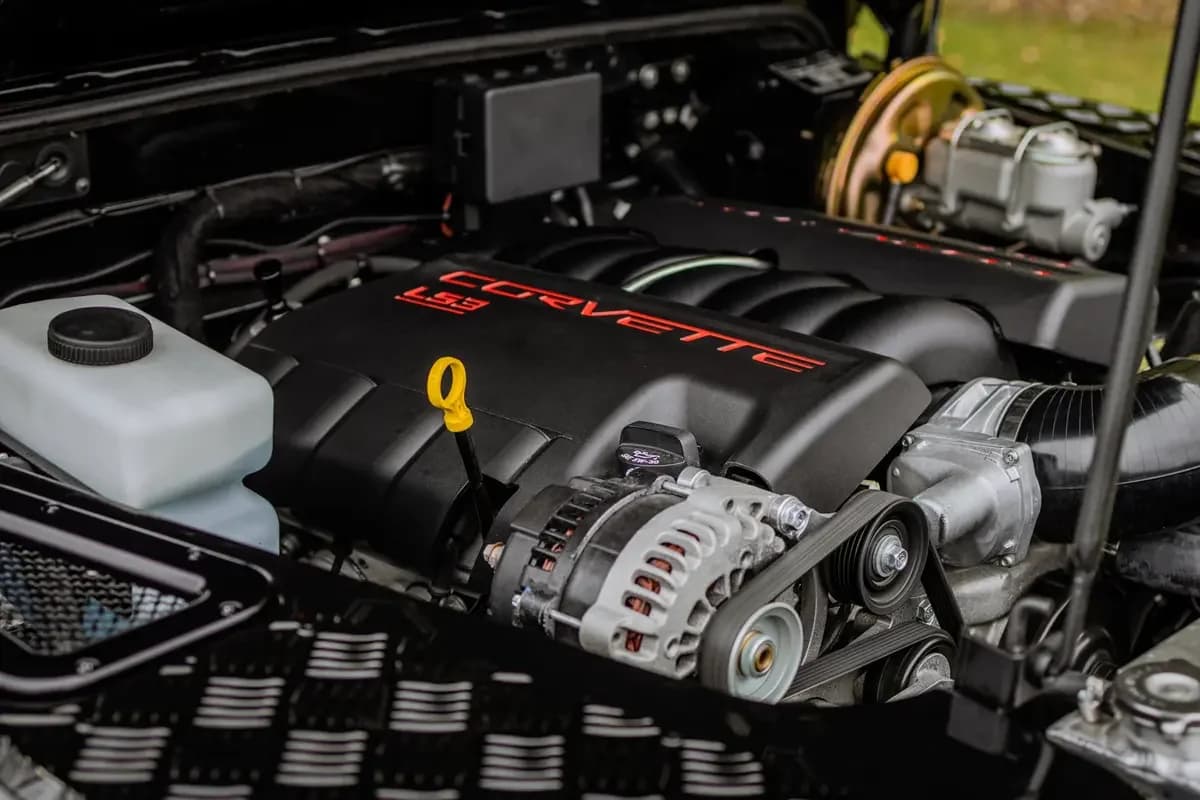
The GM LS3 and LT1: The Restomod Solution
Here's where the classic Land Rover Defender car gets genuinely interesting. The GM LS3, a 6.2-liter V8 producing 430 horsepower and 424 lb-ft of torque, transforms the Defender from a charming relic into a vehicle you can actually drive across the country without white-knuckling every highway merge.
At Monarch, the LS3 is our standard powertrain for most commissions. We pair it with the 6L80E six-speed automatic, which requires approximately 42mm of additional tunnel clearance over the original gearbox, and custom engine mounts that bolt to the existing chassis rails. The bellhousing alignment is one of the trickiest parts of the swap. Get it wrong by even a few thousandths and you'll eat through torque converters.
The LT1, the LS3's more aggressive sibling, pushes 460 horsepower and 465 lb-ft. It's the choice for clients who want the truck to feel genuinely fast, not just "fast for a Defender."
Both engines come with a GM Performance ECU, modern wiring harnesses, and, critically, they're emissions-compliant for 25-year-exempt vehicles in most states. That last point matters more than people realize.
Build Insight: The LS3 swap doesn't just add power. It fundamentally changes the ownership experience. Parts are available at any auto parts store in America. Any competent mechanic can service it. The reliability delta between a factory Rover V8 and a crate LS3 is not subtle.
Engine Information At a Glance
| Feature | Original Vintage Defender (e.g., 3.9L V8 / 300Tdi) | Monarch V8 Restoration (6.2L LT1) | Monarch Reborn Electric (BEDEO IWM) |
|---|---|---|---|
| Horsepower | 113 HP - 182 HP | 460 HP | High-Torque Electric Output |
| 0-60 MPH | 14+ seconds | Under 6 seconds | Whisper-quiet, instant acceleration |
| Reliability | Requires constant classic maintenance | Turn-key modern reliability | Zero-emissions, minimal maintenance |
| Driving Feel | Raw, agricultural, nostalgic | Aggressive, powerful, modern | Smooth, silent, future-proof |
| Best For | Purists and museum collectors | Highway driving and thrilling performance | Eco-conscious luxury and city driving |
Anatomy of a Ground-Up Build: What Makes a Land Rover Defender Car Worth the Investment
A word about the chassis, because this is where most restorations succeed or fail.
Land Rover shipped every Defender with a steel chassis protected by nothing more than a thin coat of paint[6]. In the UK's wet climate, or anywhere road salt is used, these frames rotted from the inside out. I have personally inspected 1990s-era Defenders where the rear crossmember was so corroded you could push a screwdriver through it. The truck looked fine from the outside.
That's why every Monarch build starts with a hot-dip galvanized chassis, where the entire frame is submerged in molten zinc at roughly 450°C. The zinc bonds molecularly to the steel, protecting both the interior cavities and the exterior surfaces. It is the single most important upgrade you can make to a classic Defender, and it's the one that most budget restorations skip.
Our 12-stage build process goes well beyond the chassis:
- Donor sourcing and chassis inspection
- Complete disassembly and cataloging
- Hot-dip galvanized chassis coating
- Suspension rebuild with heavy-duty components
- Drivetrain integration (LS3 or LT1 with 6-speed automatic)
- Modern wiring harness installation
- Brake system upgrade (four-wheel disc)
- Aluminum body panel restoration or replacement
- Custom exterior paint in client-specified colors
- Hand-crafted Italian leather interior
- Climate control, sound system, and electronics
- Premium LED lighting integration
- Final calibration, testing, and documentation
We change our process with time, check out our process to get the latest info!
The total build time averages eight to twelve months, although it depends on the compliance of the client and can take less if needed. That's not a timeline we apologize for. It's the timeline that quality demands.
The Body Styles: 90, 110, 130, and the Rare 6x6
The classic Land Rover Defender car came in four main configurations, each with a distinct personality.
The Defender 90 is the short-wheelbase icon. Two doors. Tight. Agile on trails. The most collectible of the lot, particularly in NAS specification. It is the one you see in magazine spreads and on Instagram.
The Defender 110 is the workhorse. Four doors, room for a family, and enough cargo space for serious expeditions. For clients who actually want to use their Defender, not just park it at a cars-and-coffee, the 110 is the better choice. And here's something the market hasn't fully priced in yet (actually, let me correct that): it is starting to price it in. 110 values have climbed steadily over the past three years as buyers realize the practical advantages.
The Defender 130 runs a 127-inch wheelbase and was originally built as a crew cab or high-capacity pickup. It is rare. Properly rare. Finding a clean 130 as a donor is one of the harder sourcing challenges we face.
Then there's the 6x6. Three axles. Six driven wheels. Originally a military specification, now an ultra-limited commission that Monarch offers for clients who want something that stops traffic. Not metaphorically.
 Check out our full comparison of the three different models here!
What a Collector Should Actually Look For
If you're considering acquiring a classic Land Rover Defender car, whether as a donor for a ground-up build or as a preserved example, here's what matters most:
Chassis condition trumps everything. A beautiful body on a rotten chassis is a money pit. Always inspect the rear crossmember, the outriggers, and the spring mounts. If you can see through the metal, walk away.
NAS provenance carries a premium. The US-legal paperwork, factory roll cage, and four-wheel disc brakes make NAS trucks a strong starting point for American collectors.
The 300Tdi era (1994–1998) is the sweet spot for restomod foundations. Mechanical simplicity, the R380 gearbox, and (on later trucks) galvanized chassis from the factory.
Documentation is worth real money. Original service books, factory build sheets, and restoration records can add 20–30% to a Defender's value at auction.
Insider Note: Grey-market Defenders, imported outside normal channels, continue to flood the US market. Hagerty specifically warns buyers to "shop carefully and ensure that any example under consideration is here legitimately"[6]. At Monarch, we verify provenance on every donor chassis before a single bolt is turned.
The Market Ahead
The classic car market is on solid footing heading into 2026. Hagerty's CEO expects continued strength, driven by a generational shift as younger collectors enter the space[5]. Millennial and Gen Z buyers are gravitating toward analog driving experiences, and the Defender, a truck you can actually feel and hear and wrestle, fits that desire perfectly.
The supply math is simple. Production ended in 2016. Every year, unrestored trucks succumb to corrosion, accidents, and neglect. The pool shrinks. Demand doesn't. Do with that information what you will.
But here's what I'll say from the bench, from someone who has spent years with their hands inside these trucks: a classic Defender is not just a financial play. It is a vehicle that makes you feel something every single time you turn the key. The first time I heard a 6.2-liter LS3 turn over in a freshly galvanized Defender chassis, I stood there grinning like an idiot. Still do.
That feeling is what collectors are really buying. The spreadsheet just happens to agree with them.
Commencing Your Commission
A Monarch is built once, from the ground up, for one owner. No client vehicles. No parts sales. No shortcuts. Our 12-stage build process produces a classic Land Rover Defender car that carries the soul of 1948 and the reliability of 2026.
If you're ready to own something singular, something that appreciates in your garage and puts a grin on your face every time you fire it up, start your commission today and speak with our build team. We'll walk you through donor selection, powertrain options, and every detail of the build, from paint codes to leather grain.
The waiting list exists for a reason.