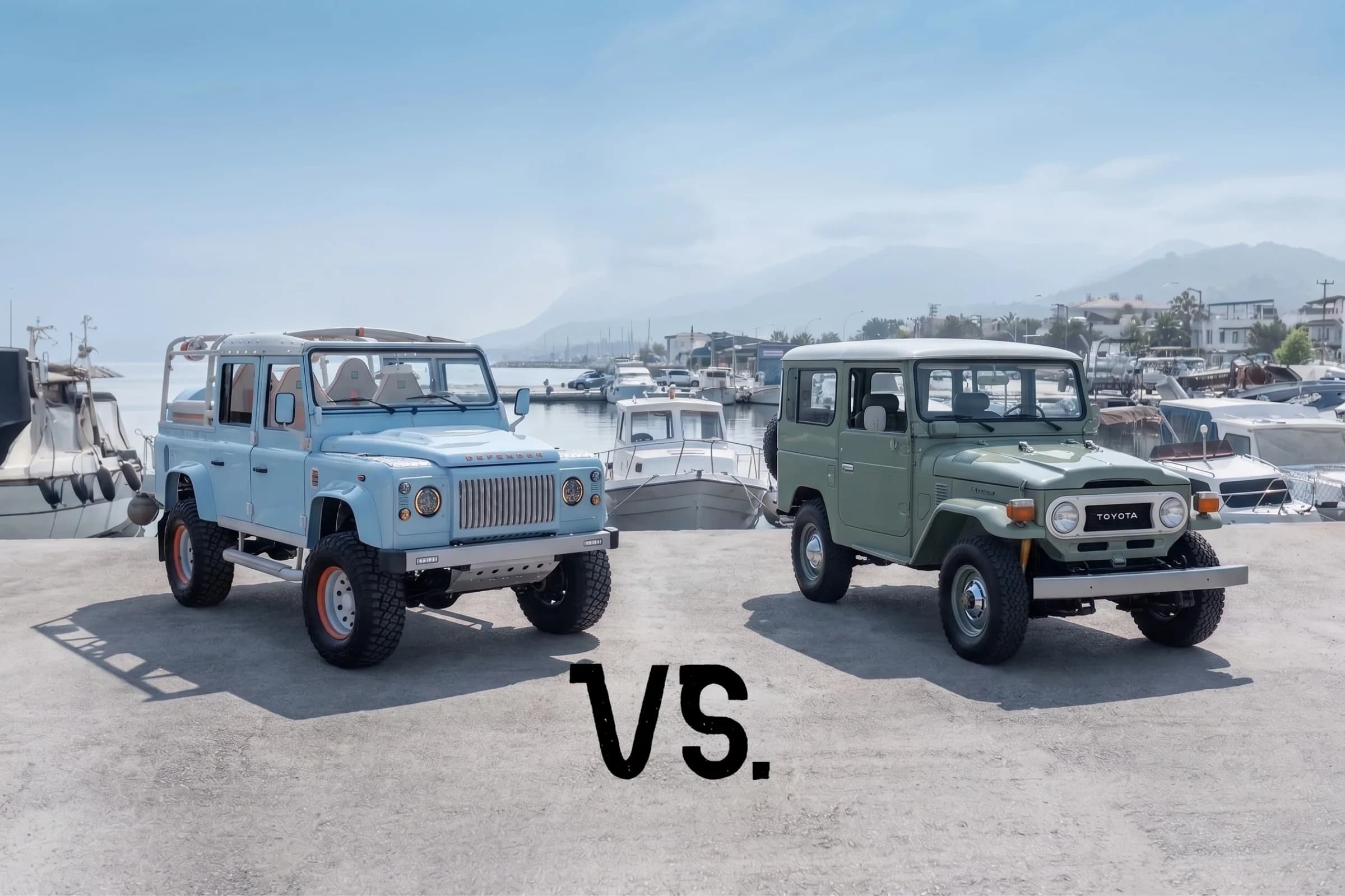
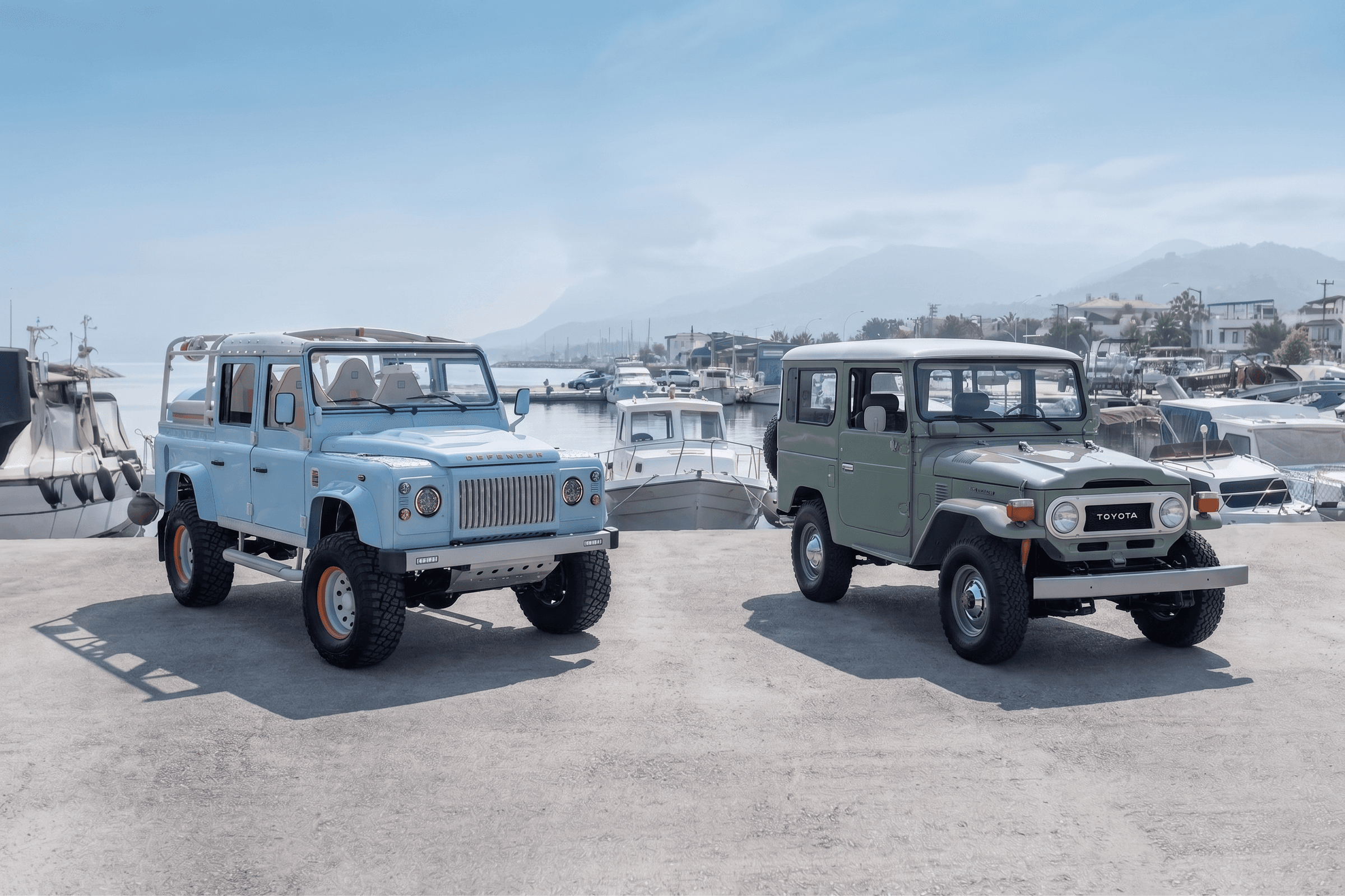
Both the classic Land Rover Defender and Toyota Land Cruiser have seen explosive 500% valuation returns since 2020. However, the Defender’s infinitely customizable platform and raw mechanical presence give it the definitive edge for high-net-worth commissions in 2026.
In August 2024, a bidding war on Bring a Trailer pushed a completely stock 1997 Toyota Land Cruiser FZJ80 with 4,700 miles to an absurd $170,000. Not to be outdone, a 1997 North American Specification (NAS) Land Rover Defender 90 hammered for $212,800 in late 2025.[1]
You read those numbers correctly.[2] We are talking about utility vehicles originally designed to herd sheep and cross unpaved ravines. Now they command supercar money.
I have personally overseen ground-up Monarch builds since 2016. I watch this market daily. You want to know the real difference between these two legends? The Toyota was built to be a flawless, unbreakable machine that asks nothing of you. The Land Rover was built to be driven. It forces you to participate. You feel the mechanical symphony of the heavy transfer case, the rigid solid axles articulating over unpaved rocks, and the sheer, undeniable weight of automotive history echoing through the heavy steering rack as you negotiate a turn.
Let's settle the debate.
Market Valuations: What the Auction Data Shows
For collectors in 2026, the Land Rover Defender outpaces the Toyota Land Cruiser in sheer auction ceiling, specifically driven by the premium placed on custom, ground-up restomods featuring modernized drivetrains. Original Land Cruisers maintain steady appreciation, but lack the six-figure customization headroom.
If you bought a clean FJ40 or NAS D90 a decade ago, congratulations. You outperformed the S&P 500.
Hagerty valuation data from early 2026 paints a clear picture of the current market. A pristine 1978 FJ40 regularly trades in the $40,000 to $52,500 range, with heavily modified examples occasionally touching six figures.[3] The 80-Series Land Cruiser, specifically the 1993-1997 run, has officially graduated from cheap overlanding rig to serious collector piece. That $170,000 FZJ80 sale proved it. Collectors want well-preserved, low-mileage examples of modern-classic Japanese vehicles.[1]
But the Defender market operates in a different stratosphere entirely.
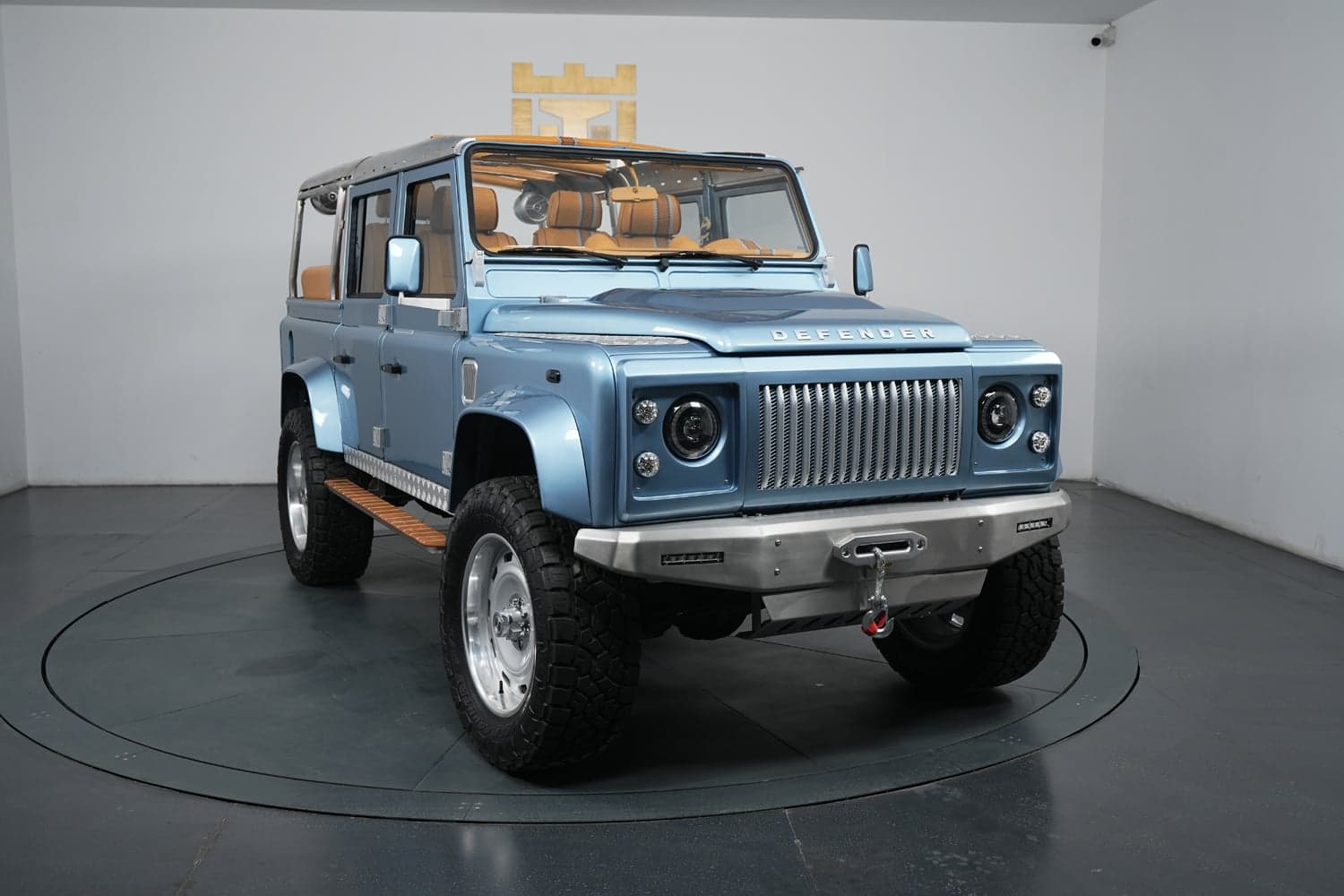
The limited run of US-legal NAS Defenders, roughly 7,000 total units built between 1993 and 1997, created an artificial scarcity that set the baseline, pushing prices for even mediocre examples into territory once reserved for air-cooled Porsches.[2] Today, a ratty, high-mileage 1994 D90 with rust issues will still pull $40,000. A clean original? $105,000 to $155,000. And a fully modernized, bespoke build with a GM V8 powertrain?[4][5] Those routinely clear $250,000.
You can browse our available inventory to see exactly how these top-tier builds are optioned.
The Land Cruiser is an appreciating asset. The Defender is an entire asset class. The ceiling for a classic Defender is dictated only by the imagination of the builder and the depth of the client's vision.
The Hardware: Engineering Philosophies
Toyota engineered the Land Cruiser to be utterly bulletproof, relying on heavy components and precise factory tolerances. Land Rover designed the Defender as a modular erector set: a simple, aluminum-bodied canvas that can be completely rebuilt, galvanized, and upgraded from the frame up.
The 4.5-liter 1FZ-FE inline-six in the FJ80 is a masterpiece of reliability. It produces 212 horsepower. It generates 275 lb-ft of torque.[1] It will run for 300,000 miles if you occasionally remember to change the oil.[1]
But reliability and soul are rarely the same thing.
When we strip a classic Defender down to its bare metal in our shop, the critical first step of our 12-stage manufacturing process, you see the genius of Solihull's original design. It is brilliant. The body panels are aluminum. They won't rust. The frame is steel. It will rust. Actually, let me correct that: it did rust, which is exactly why we discard the original paint-coated factory frames and build upon a brand new KTL-coated, galvanized chassis.
Toyota built the FJ40 and FJ60 with heavy steel bodies that dissolve in the presence of road salt. Restoring an FJ requires cutting out quarter panels, welding in patch panels, and fighting decades of iron oxide just to get back to zero, whereas a Land Rover simply unbolts into its constituent pieces.
With a classic Defender (1983-2016), you unbolt the bulkhead, lift off the tub, and replace what you want. It's automotive Lego. This modularity is exactly why the Defender makes a vastly superior platform for a custom commission. If you want to understand how we completely renew this architecture, our build process explains the engineering.
The Lineup: Body Styles and Configurations
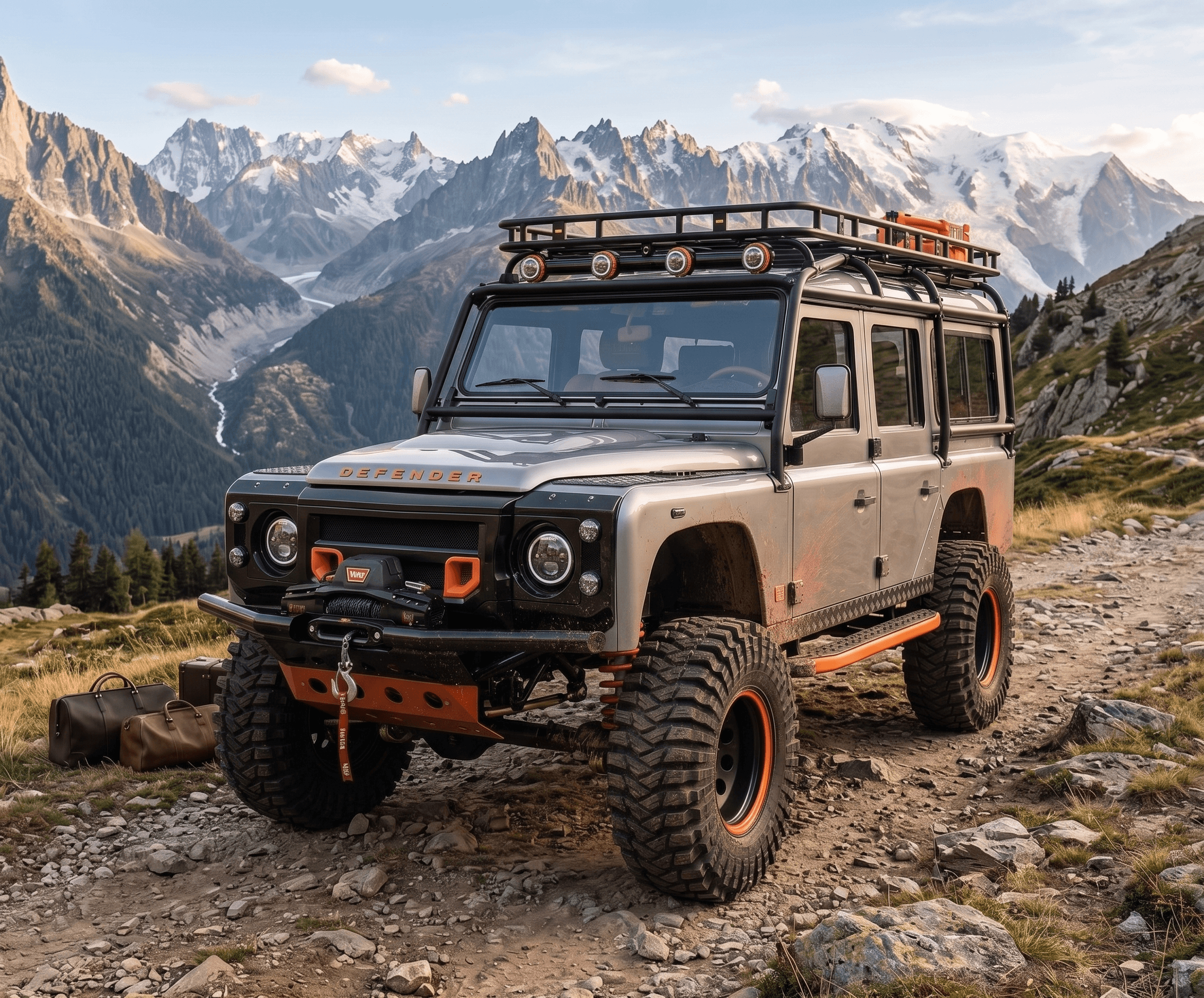
The classic Land Rover Defender retained its agricultural origins, consistently offering the 90, 110, and 130 wheelbases to suit any specific collector's lifestyle requirement. The Toyota Land Cruiser evolved into a large, comfortable wagon over its lifespan, abandoning its utilitarian roots.
The classic Defender era covers 33 years of production. Same basic shape. Same doors. Same windshield. And yet no two model years are exactly alike. Land Rover offered the nimble Defender 90, the family-hauling Defender 110, the massive Defender 130, and even specialty variants like the 6x6.
You need to know which wheelbase you're buying.
The 90 is a canyon carver for the dirt. The 110 is the ultimate statement piece for a Sunday cruise to the yacht club. The 130 is a behemoth that commands absolute respect in any zip code on the planet.
Toyota's lineage is entirely different. The FJ40 was a direct competitor to the short-wheelbase Land Rover. But as the decades passed, Toyota chased luxury. The FJ60 became a station wagon. The FJ80 became a leather-lined isolation chamber. They lost the raw, unadulterated edge that made them special in the first place.
This is why collectors flock to the Defender. It never compromised. It never tried to be a soft luxury crossover. It remained a brick on wheels until the last classic model rolled off the line in 2016.
Drivetrains and Performance: The V8 Advantage
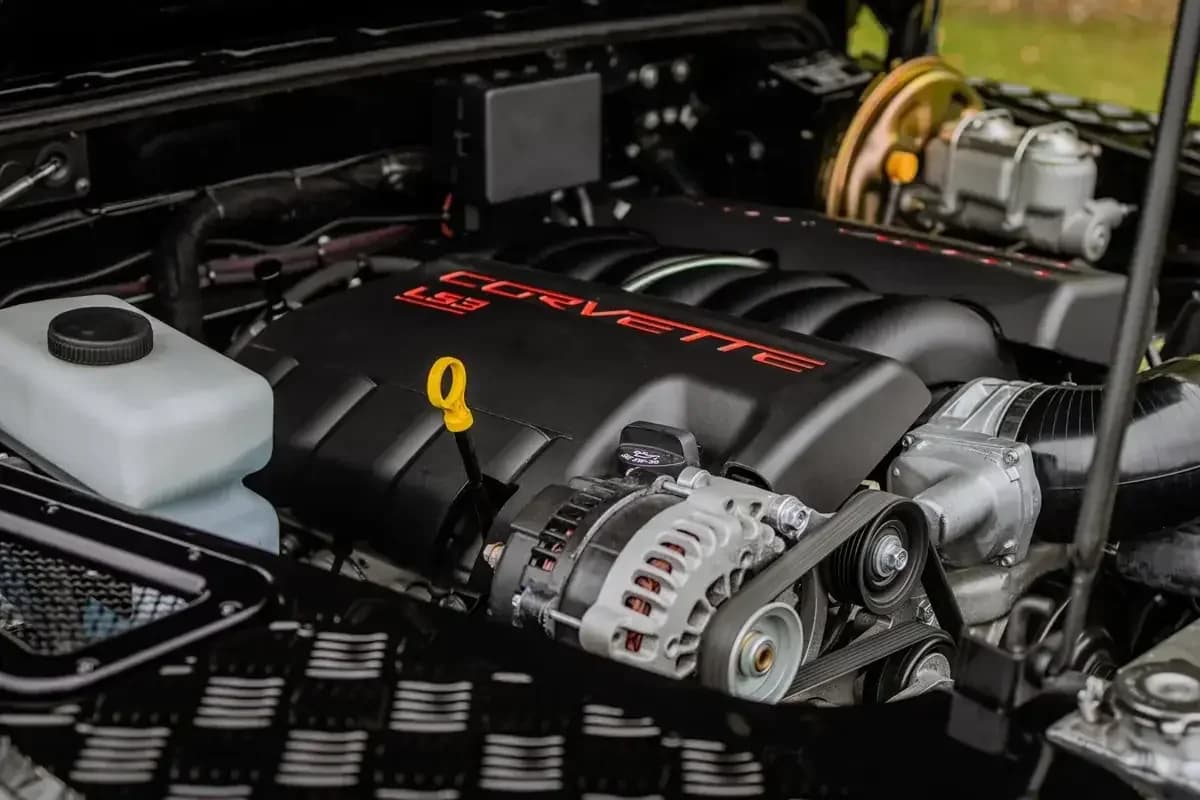
The original Land Rover engines were underpowered by modern standards, which is why bespoke builds replace them with 430-hp GM LS3, 460-hp LT1 or 650-hp supercharged LT4 V8s. Land Cruisers generally retain their stock inline-sixes, keeping them authentic but incredibly slow for 2026 traffic.
You want to know the real problem with the original Defender engines? The 68 horsepower 2.5 naturally aspirated diesel. Or even the later 122 horsepower Td5. They were built for low-end torque in muddy British farm fields, not merging onto a Texas interstate at 75 miles per hour. Even the 4.0-liter Rover V8 in the 1997 NAS trucks feels asthmatic today.
Toyota's engines were better out of the box. But they aren't thrilling.
This is the exact moment the classic 4x4 paths diverge. The Land Cruiser community is obsessed with purity. They want the original F-block engines. They want original carburetors. They want to drive 55 mph and accept it.
We don't accept it.
At Monarch, we do not restore client vehicles or sell bolt-on accessories. Every truck we produce is a ground-up, bespoke commission, and that means permanently correcting the factory's horsepower deficit. We build with the GM LS3 (6.2L V8, about 430 hp, 424 lb-ft), LT1 (6.2L V8, about 460 hp, 465 lb-ft) or supercharged LT4 (650 hp), paired exclusively with a heavy-duty 6-speed automatic transmission, and we also offer EV builds.
The way the LS3 pulls from 2,000 RPM in third gear on a gravel road will completely rewire your brain.
It takes a tractor. It turns it into a ballistic missile.
The Driving Experience: Analog vs Appliance
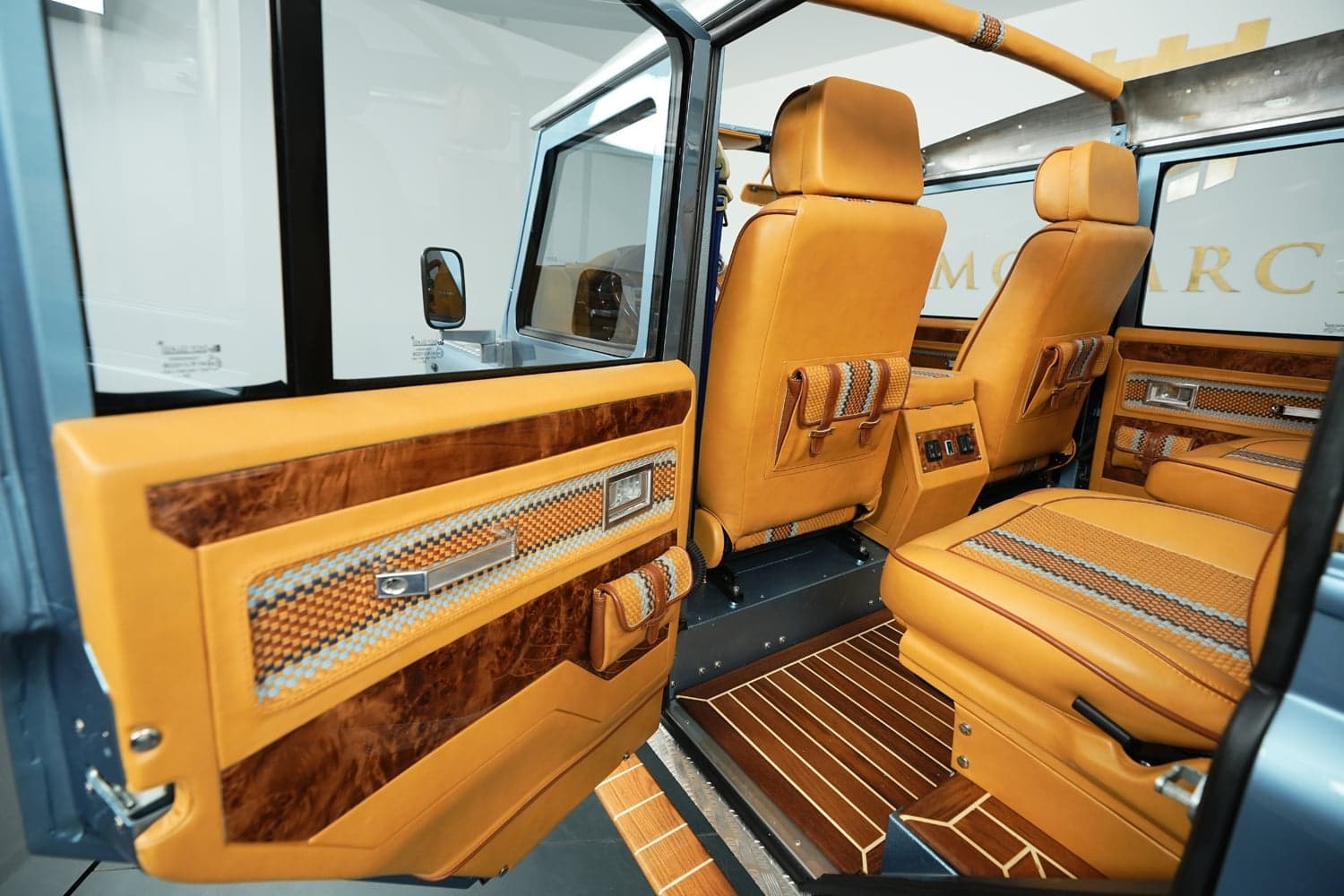
A classic Toyota Land Cruiser naturally drives with predictable, heavy stability. The custom Land Rover Defender delivers a visceral, sensory-rich experience where you feel every mechanical input, made entirely comfortable through modern suspension damping and hand-stitched, Concours-level custom Italian leather interiors.
Get behind the wheel of an FJ60. It feels like a truck. A good, slow, very heavy truck. The steering is vague. The suspension crashes over potholes.
Now get into a properly built Defender 110.
You sit right up against the door glass. The seating position is commanding. You look out over that flat, unmistakable hood, and you realize you are piloting an absolute icon. The visibility is spectacular.
Yes, a stock 1990s Defender rides like a farm implement. But a ground-up bespoke build is a different animal. We install heavy-duty suspension systems with modern damping technology to tame the solid axles. We fit custom-mixed exterior paint to Concours-level standards. We wrap the interior in hand-stitched Italian leather that rivals anything coming out of Maranello. We design a bespoke, modernized electronics and wiring use so your gauges actually work, your engine runs with fuel-injected precision, and your climate control blows ice cold in the middle of a sweltering July afternoon.
You get the analog soul of a 1980s icon. But you get the fit, finish, and reliability of a modern luxury vehicle. You can read stories of clients experiencing this exact transformation on our blog.
The Aesthetics: Why the Defender Turns More Heads
The classic Land Rover Defender possesses an unmistakable, boxy silhouette that commands immediate attention in any environment. The Land Cruiser, particularly the later wagon models, blends into traffic with a much softer, generic profile that fails to capture the same level of automotive imagination.
Park an FJ80 next to a Defender 110 at a valet stand. Watch what happens.
The Toyota disappears. It looks like a nice, old SUV. People walk right past it without a second glance.
The Defender stops traffic. People take photos. They ask questions. The exposed hinges. The flat glass. The rivets running down the rear tub. It is industrial art. It screams adventure in a way that no other vehicle on earth can manage. The Defender is the best-looking 4x4 ever produced. Full stop.
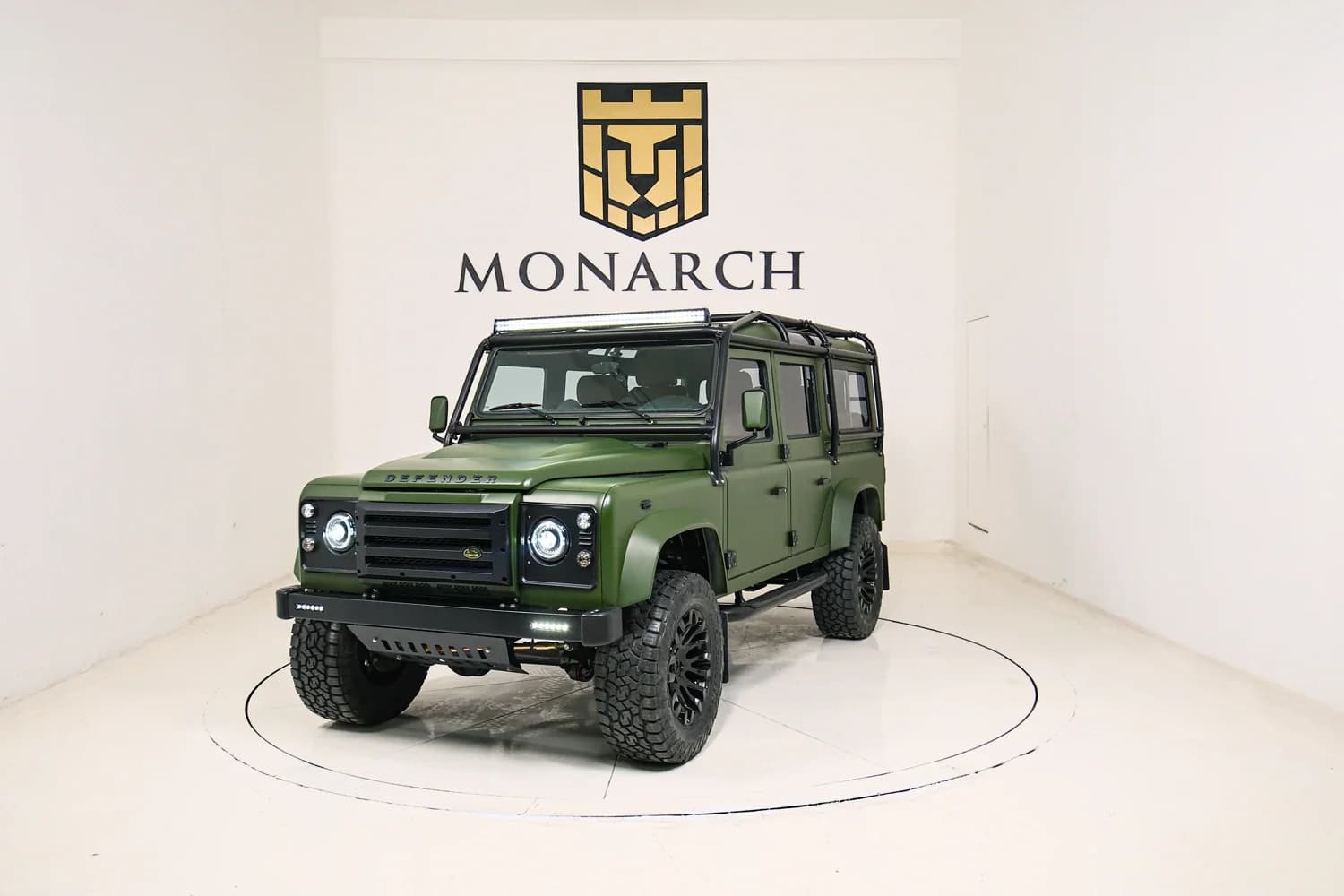
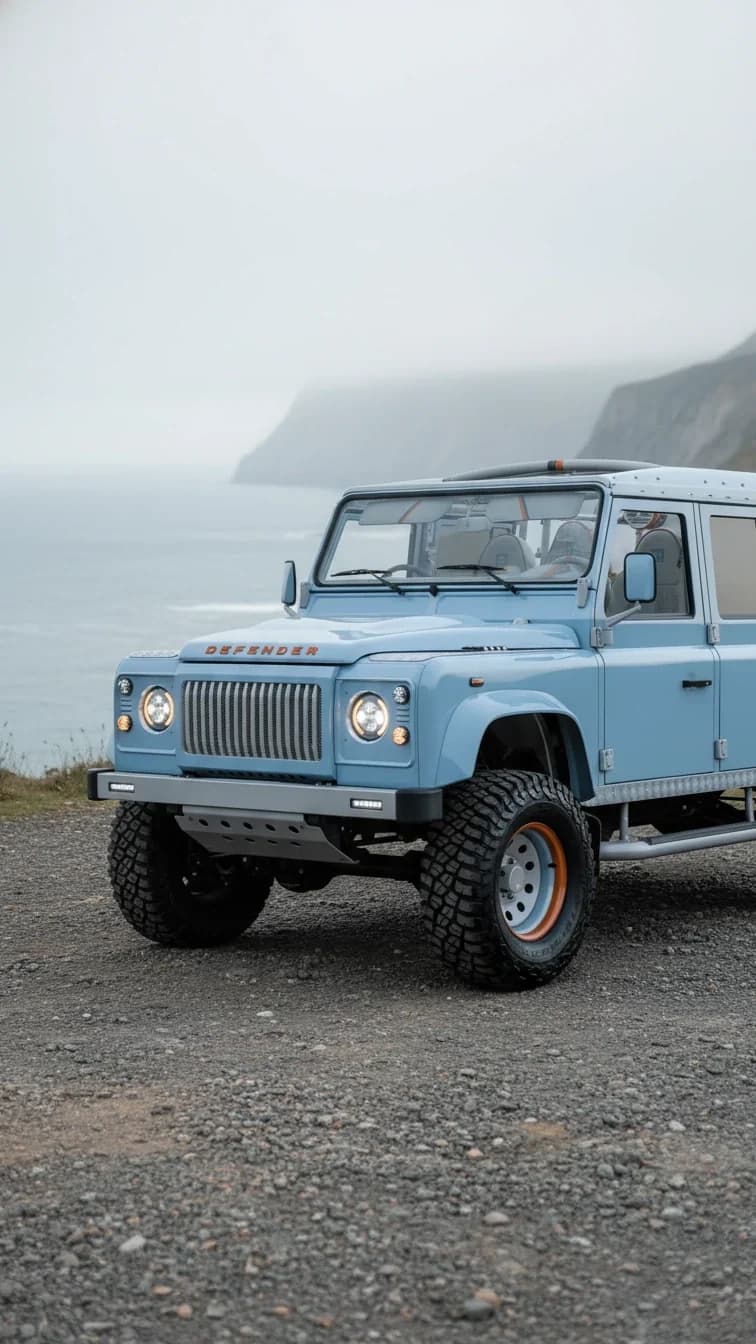
When we mix custom paint for a client, we aren't just spraying a body. We are highlighting 33 years of heritage. A dark metallic green with a contrasting Alpine White roof, sitting on color-matched Wolf steel wheels? It is visual perfection.
Why the Classic Defender is the Ultimate Commission
While the Toyota Land Cruiser remains a steadfast collector vehicle, the classic Land Rover Defender (1983-2016) is the absolute pinnacle for high-end commissions due to its iconic silhouette, modular aluminum construction, and unique ability to house massive V8 power without losing its character.
I respect the Land Cruiser. I really do. If I had to drive across the Sahara in 1985 with no spare parts, I would take an FJ40.
But we aren't in 1985. We are in 2026.
Collectors today aren't buying these vehicles because they need to survive the apocalypse. They buy them because modern SUVs feel like driving an appliance. They buy them because they want to feel something real.
The Land Rover Defender provides a visceral connection to the road that no modern L663 Defender can replicate. It is the best classic 4x4 platform in the world.
When you look at our past projects, you are not looking at refurbished old trucks. You are looking at zero-mile masterpieces. We strip the history down to the bare aluminum, set it on a new KTL-coated, galvanized chassis, and inject 430 horsepower into the bloodstream. It is a 12-stage resurrection.
Toyota built an appliance you can trust. Land Rover built a legend you can feel.
Stop settling for vehicles built for the masses. If you are tired of generic SUVs and want a vehicle tailored exactly to your specifications, it's time to start the process of commissioning a vehicle that actually makes you feel something behind the wheel. Explore our 12-stage manufacturing process and contact us today to secure your allocation for a bespoke, ground-up Defender commission.